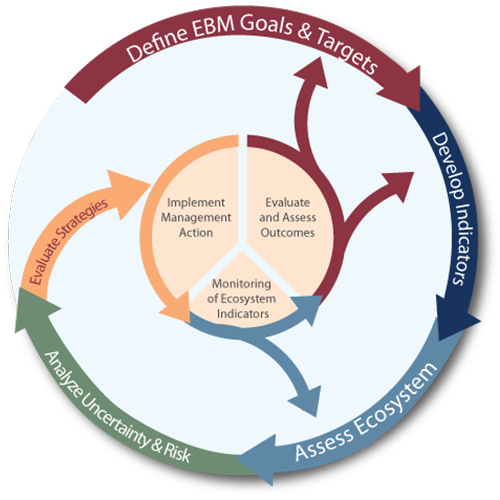
State of the Ecosystem
New England 2025
NEFMC
March 10, 2026
State of the Ecosystem: Maintain 2024 structure for 2025
2025 Report Structure
- Graphical summary
- Page 1 report card re: objectives →
- Page 2 risk summary bullets
- Page 3 2024 snapshot
- Performance relative to management objectives
- Risks to meeting management objectives
- Climate and Ecosystem risks
- Offshore wind development
- 2024 Highlights


Ecosystem synthesis themes
Characterizing ecosystem change for fishery management
- Societal, biological, physical and chemical factors comprise the multiple system drivers that influence marine ecosystems through a variety of different pathways.
- Changes in the multiple drivers can lead to regime shifts — large, abrupt and persistent changes in the structure and function of an ecosystem.
- Regime shifts and changes in how the multiple system drivers interact can result in ecosystem reorganization as species and humans respond and adapt to the new environment.


State of the Ecosystem report scale and figures

A glossary of terms (2021 Memo 5), detailed technical methods documentation and indicator data are available online.
Key to figures
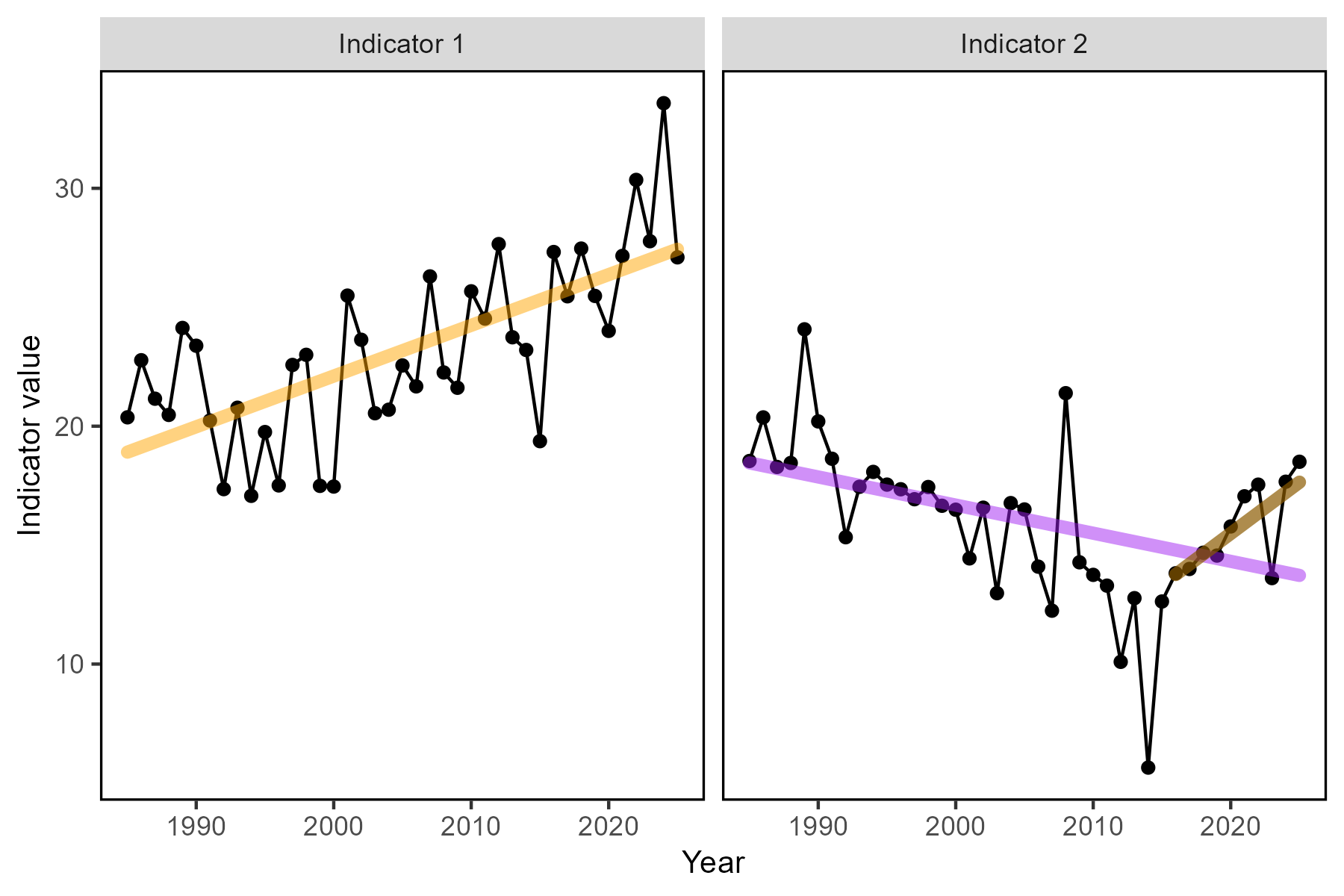
Long-term trends assessed only for 30+ years: more information
Short-term trends assessed for last 10 years of data OR a full time series <30 years
Orange line = significant increase
Purple line = significant decrease
No color line = not significant or < 30 years
Grey background = last 10 years
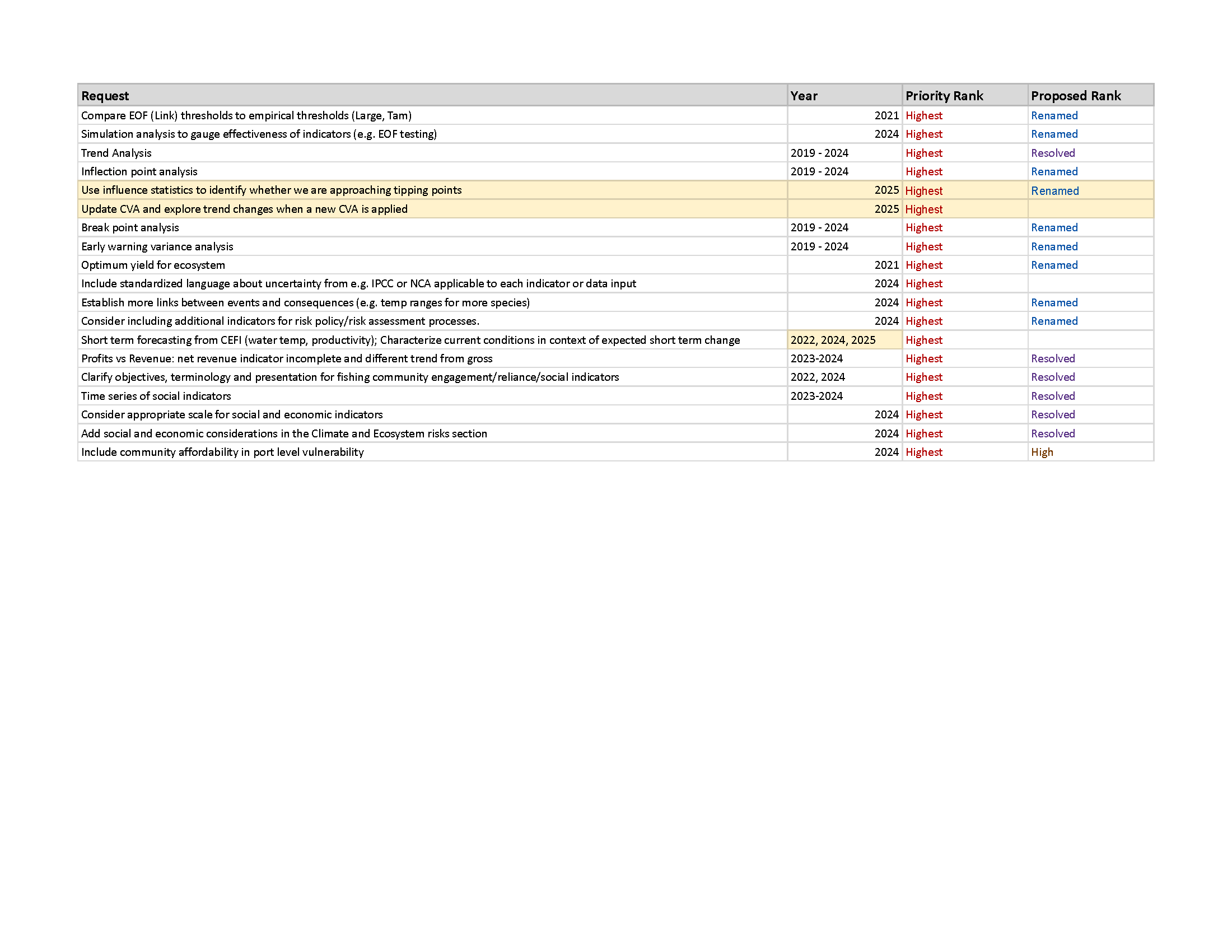
2025 State of the Ecosystem Request tracking memo: updates noted along the way
New England State of the Ecosystem Summary 2025:
Performance relative to management objectives - Georges Bank
Seafood production Total  , Managed
  , Both
Profits ,
Recreational opportunities: Effort  Effort diversity
Stability: Fishery not stable; Ecological not stable
Social and cultural:
Fishing engagement and social vulnerability status by community
Revenue climate vulnerability
![mixed trend icon]() , majority medium risk
, majority medium risk
 , majority medium risk
Protected species:
Maintain bycatch below thresholds (harbor porpoise, gray seals)
![mixed trend icon]()
![meeting objectives icon]()
Recover endangered populations
![mixed trend icon]() , NARW
, NARW ![below average icon icon]() Gray seal
Gray seal ![above average icon icon]()


New England State of the Ecosystem Summary 2025:
Performance relative to management objectives - Gulf of Maine
Seafood production ,
Profits Total , ; NEFMC managed ,
Recreational opportunities: Effort Effort diversity
Stability: Fishery not stable; Ecological not stable
Social and cultural:
Fishing engagement and social vulnerability status by community
Revenue climate vulnerability
![mixed trend icon]() , majority medium risk
, majority medium risk
Protected species:
Maintain bycatch below thresholds (harbor porpoise, gray seals)
![mixed trend icon]()
![meeting objectives icon]()
Recover endangered populations
![mixed trend icon]() , NARW
, NARW ![below average icon icon]() Gray seal
Gray seal ![above average icon icon]() Salmon
Salmon ![below average icon icon]()

State of the Ecosystem Summary 2025:
Risks to meeting fishery management objectives
Climate: risks to managing spatially, managing seasonally, and catch specification
Fish and protected species distribution shifts
Changing spawning and migration timing
Multiple stocks with poor condition, declining productivity
Other ocean uses: offshore wind development
- Current revenue in proposed areas
- 1-32% by New England port
- 1-20% by NEFMC
- Overlap with important right whale foraging habitats, increased vessel strike and noise risks

State of the Ecosystem Summary 2025: 2024 Highlights
Notable 2024 events and conditions
2024 warmest year on record globally. Again.
BUT
Cooler conditions across the coast
Well established Mid Atlantic Cold Pool
Multiple summer upwelling events off NJ
Extreme ocean acidification measured off NJ
Many fishery observations of different spatial and timing patterns, changed abundance
Good scallop recruitment in Nantucket lightship
More red drum in Chesapeake Bay
Arctic copepods in GOM
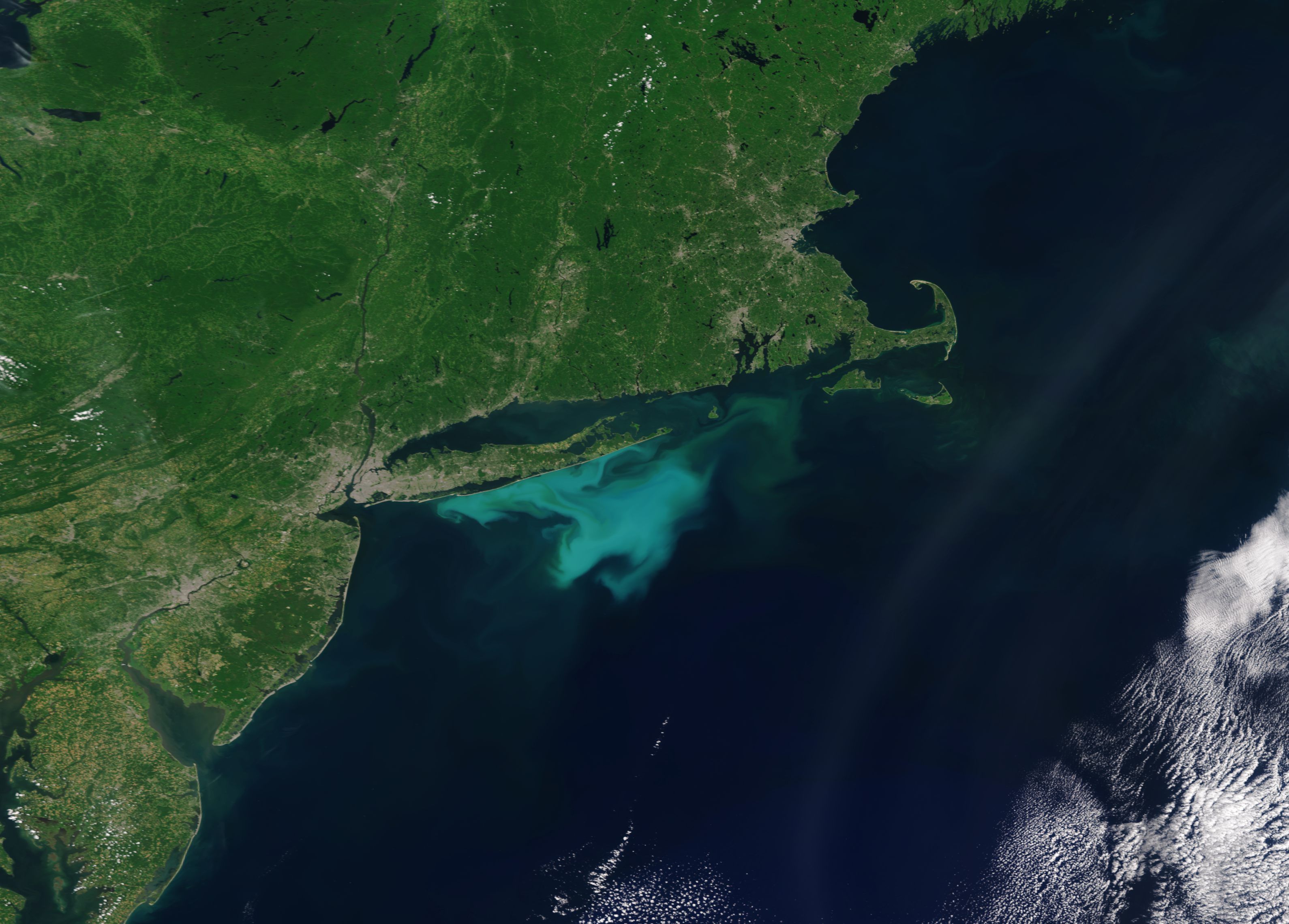
Cocolithophore bloom off NY
Large whale aggregations
We welcome your observations! northeast.ecosystem.highlights@noaa.gov
2025 Performance relative to management objectives


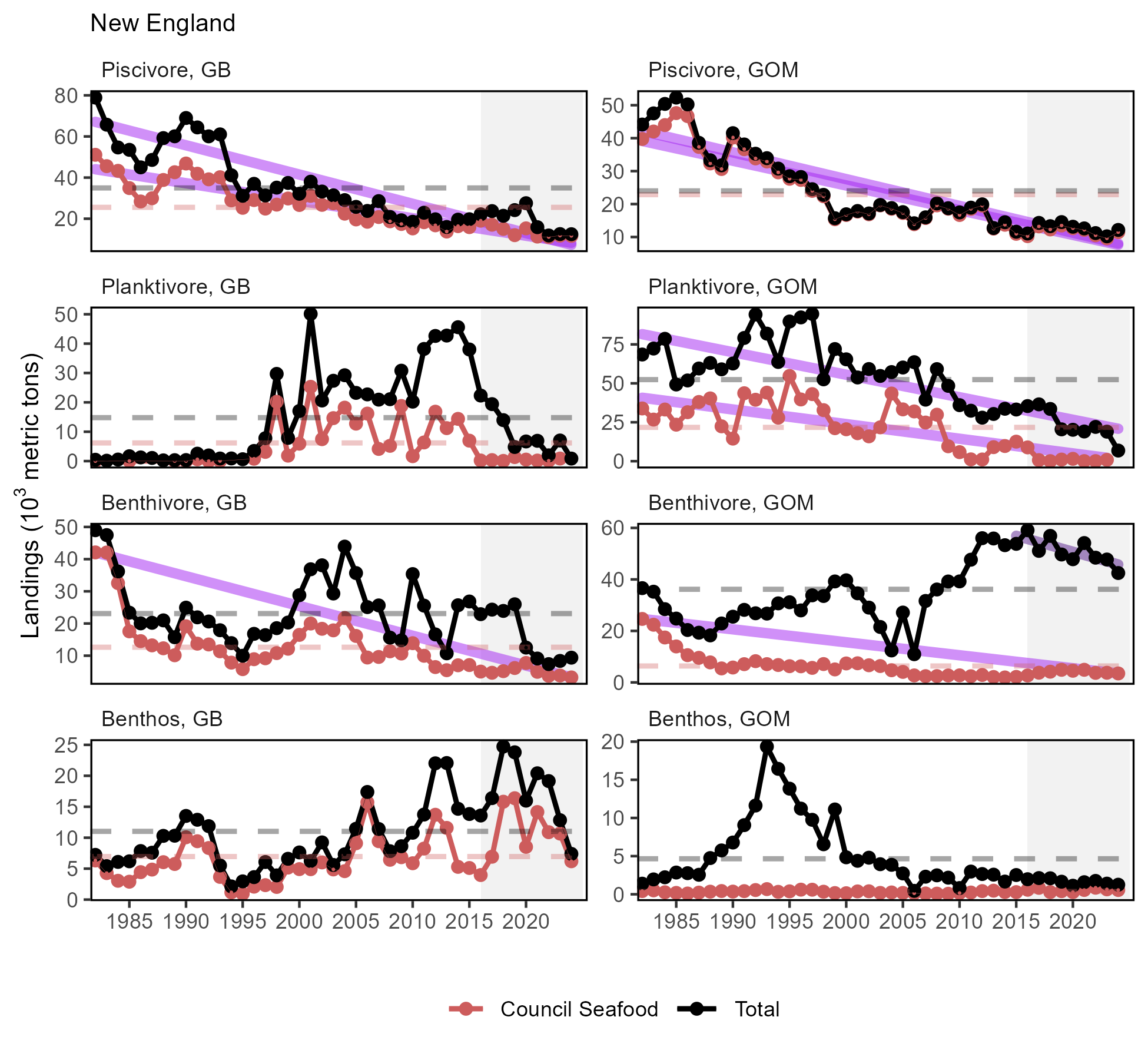
Objective: New England Seafood production ![decreasing arrow icon]()
![no trend icon]()
![below average icon icon]()
Indicators: Commercial landings, climate risk
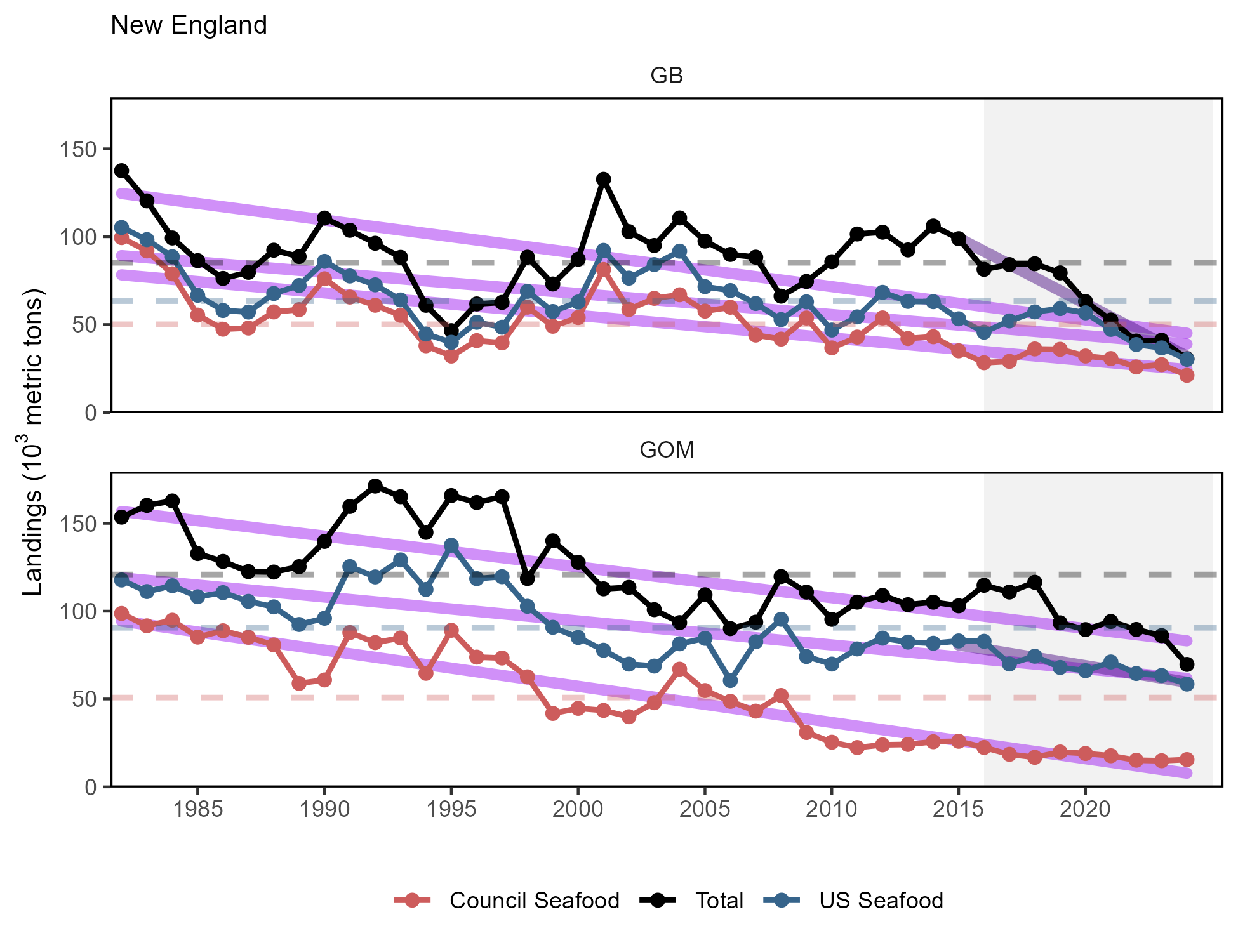
Multiple drivers: ecosystem and stock production, management actions (stock rebuilding), market conditions (including COVID-19 disruptions), and environmental change
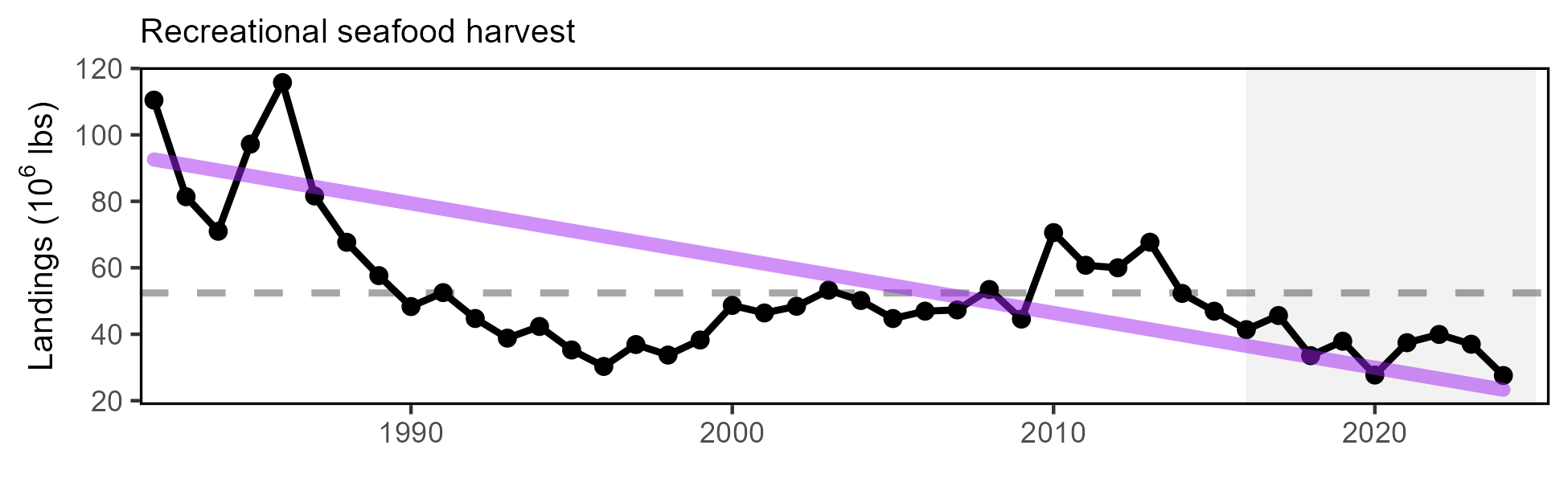
Indicators: Recreational harvest

New England drivers: Stock status? Survey biomass?
Indicator: Stock status
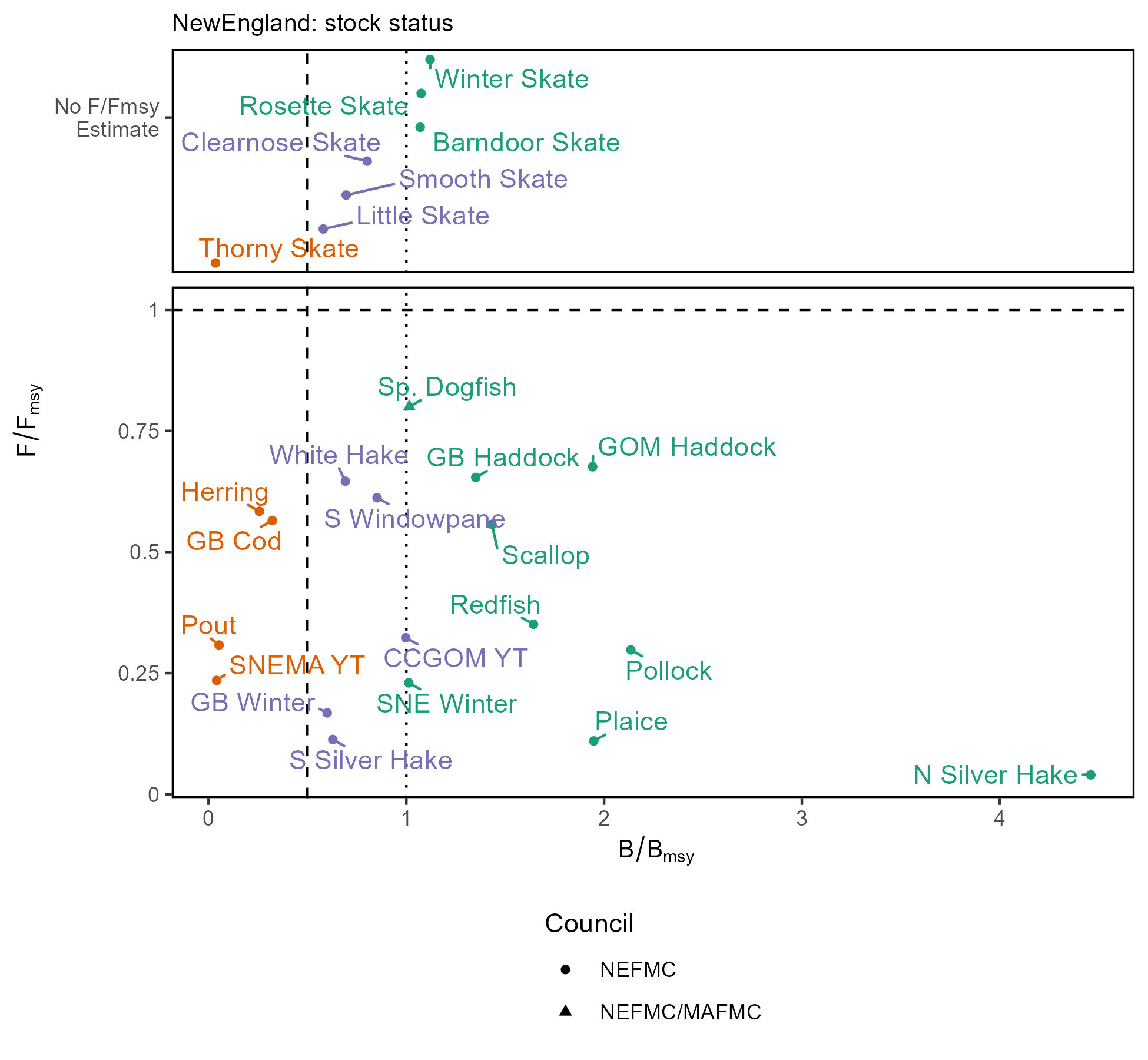
GB Haddock & Plaice now have B/Bmsy >1. GOM Haddock now has F/Fmsy < 1. Stock status and required management actions still likely playing large role in seafood declines.
Indicators: Survey biomass
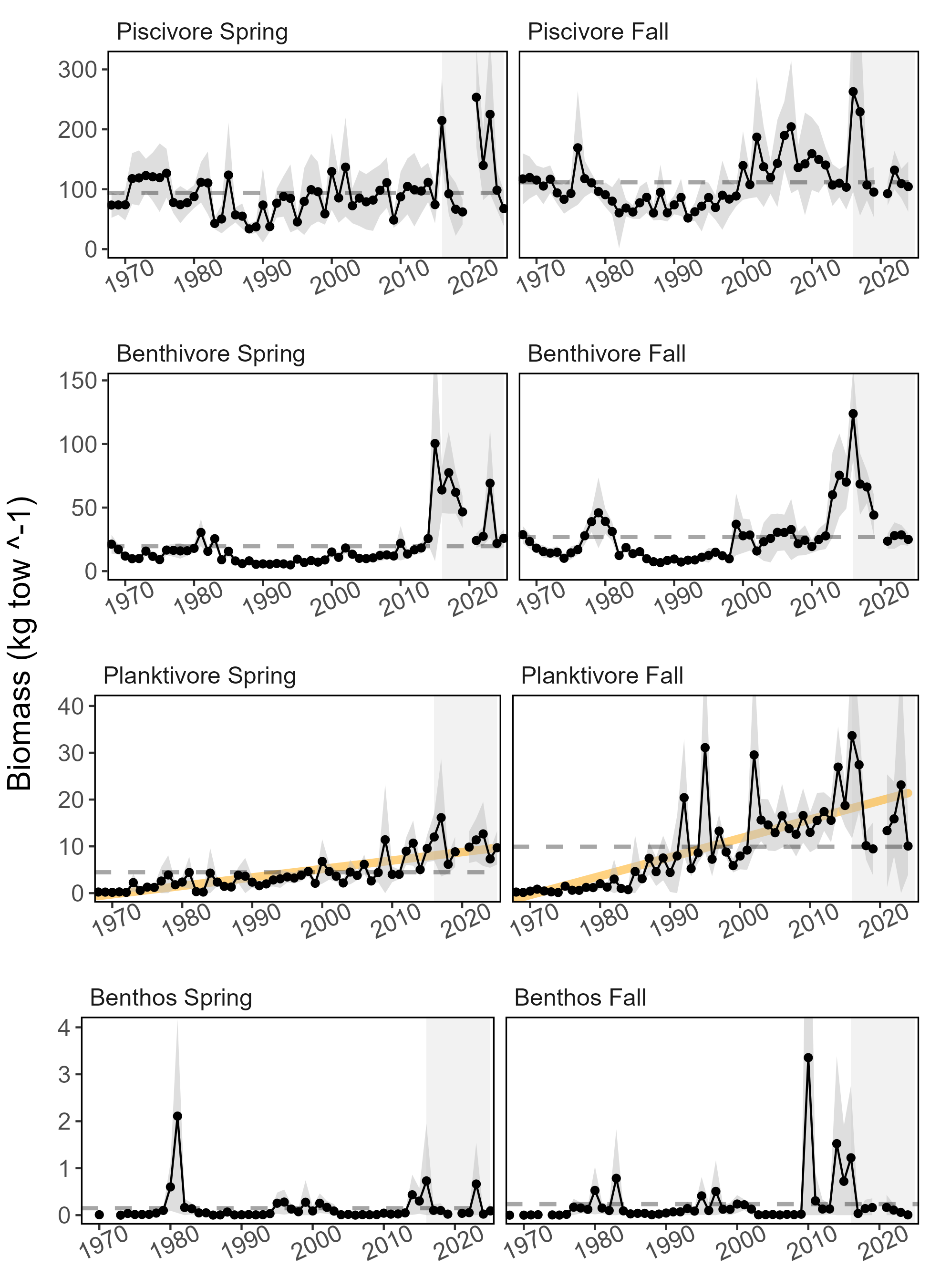
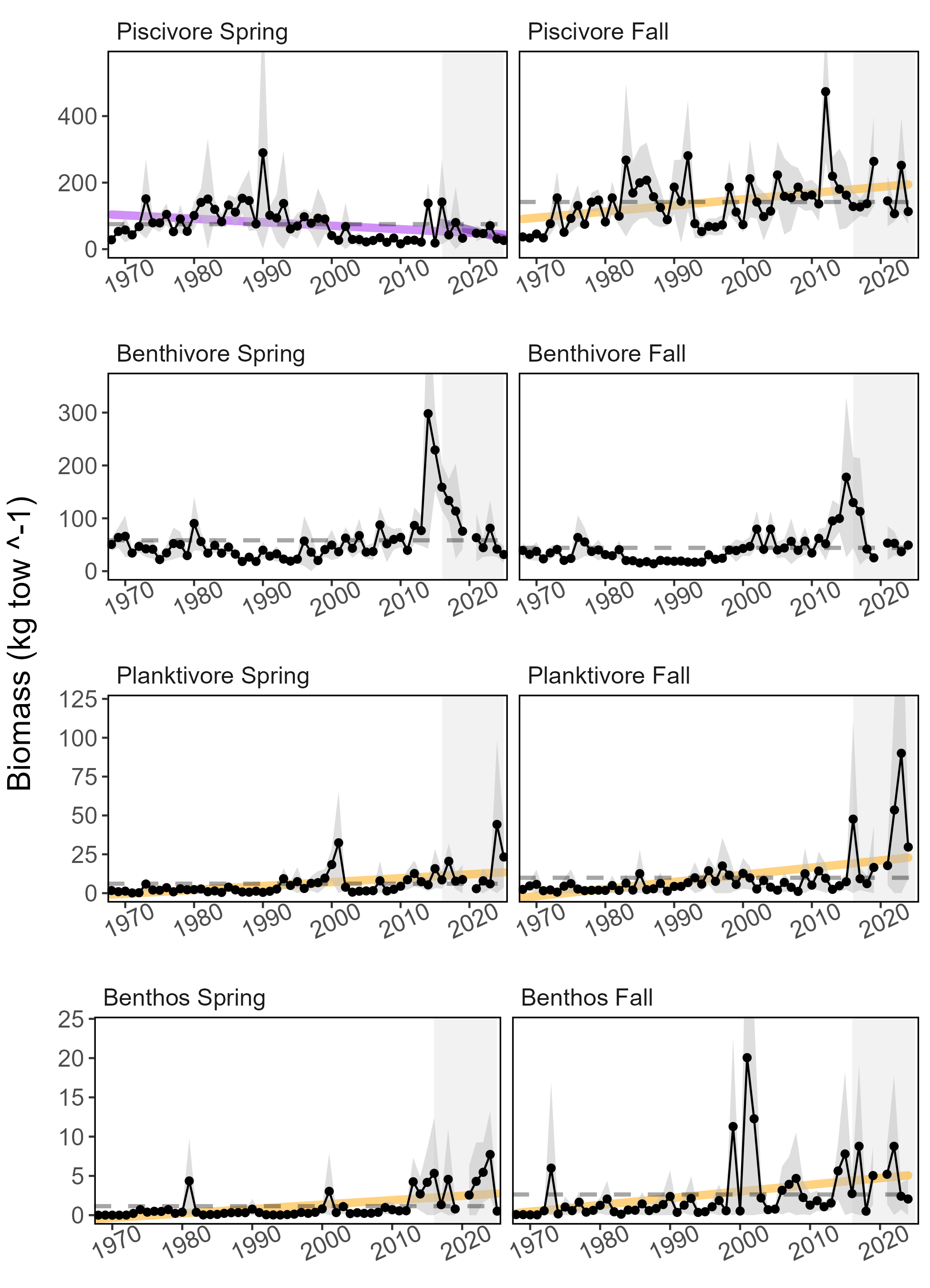
Biomass availability still seems unlikely driver
Implications: New England Seafood Production
Drivers:
- Decline in commercial landings is most likely driven by actions to rebuild individual stocks (lower quotas) as well as market dynamics
- other drivers affecting recreational landings: tighter shark fishery regulations, changing demographics and preferences of anglers
Monitor:
- Climate risks including warming, ocean acidification, and shifting distributions
- Ecosystem composition and production changes
- Fishing engagement

Objective: New England Commercial Profits ![mixed trend icon]()
![below average icon icon]()
Indicator: Commercial Revenue; profit indicators under SSC review
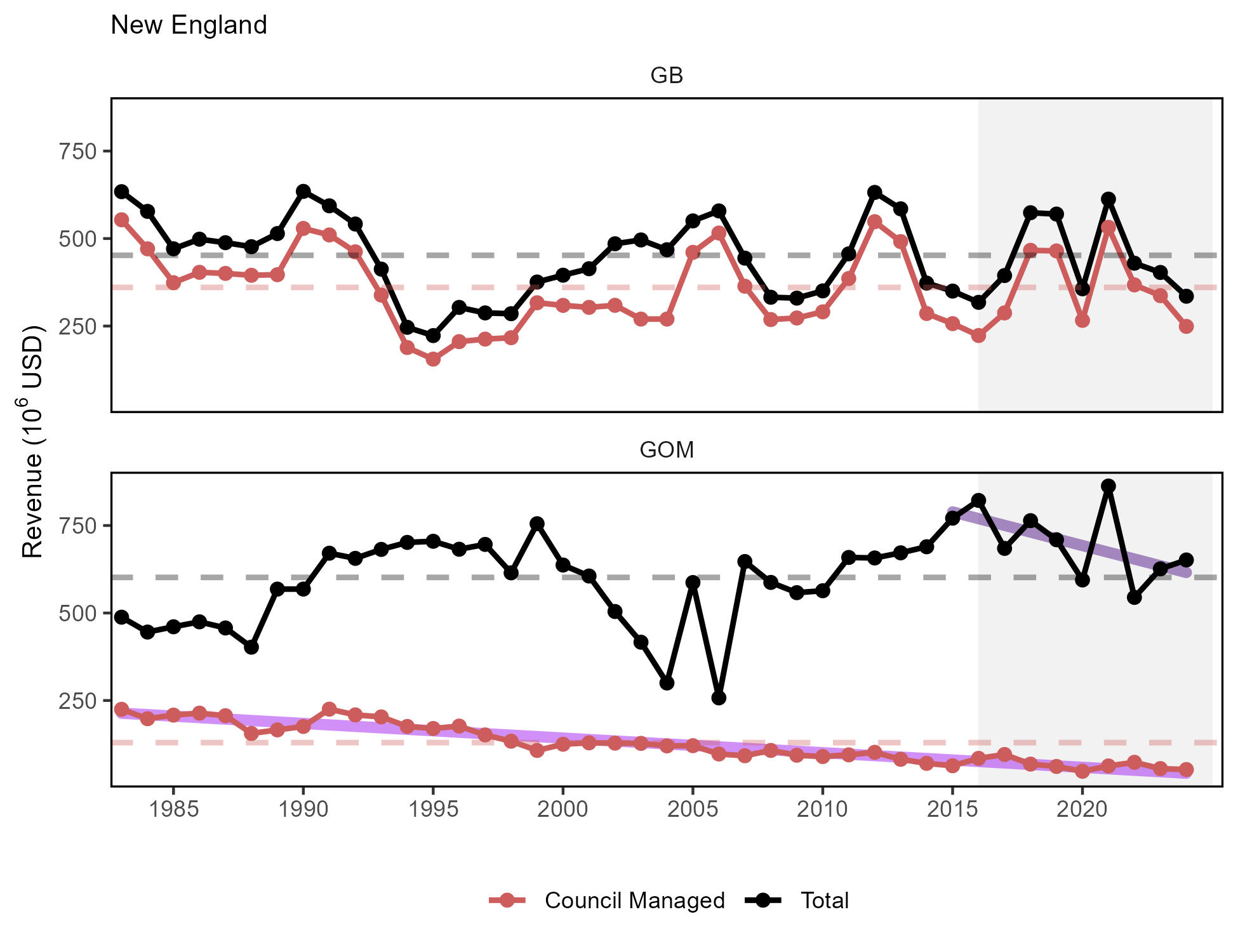

Both regions dependent on single climate-vulnerable species
Indicator: Bennet–price and volume indices
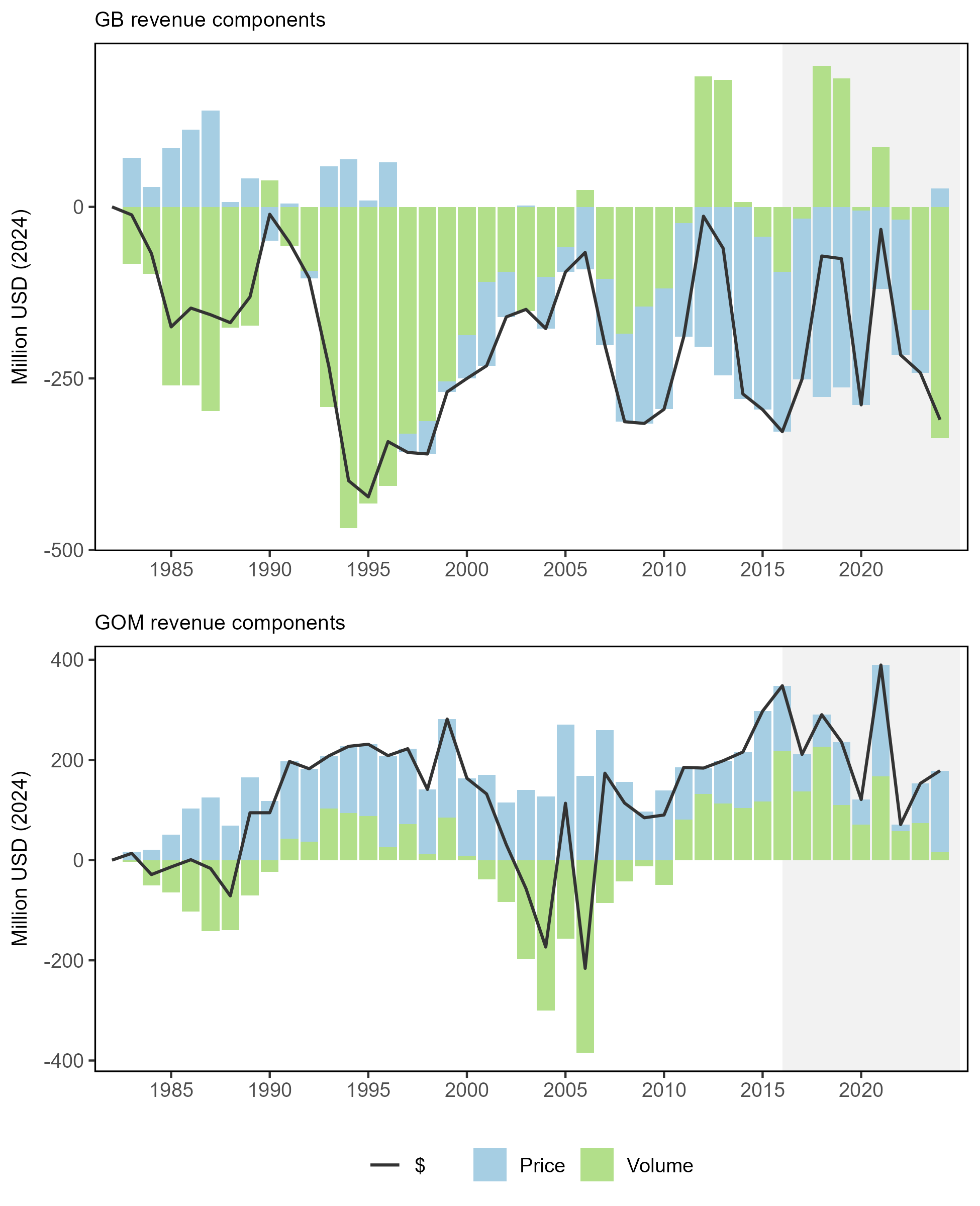
GOM high revenue despite low volume
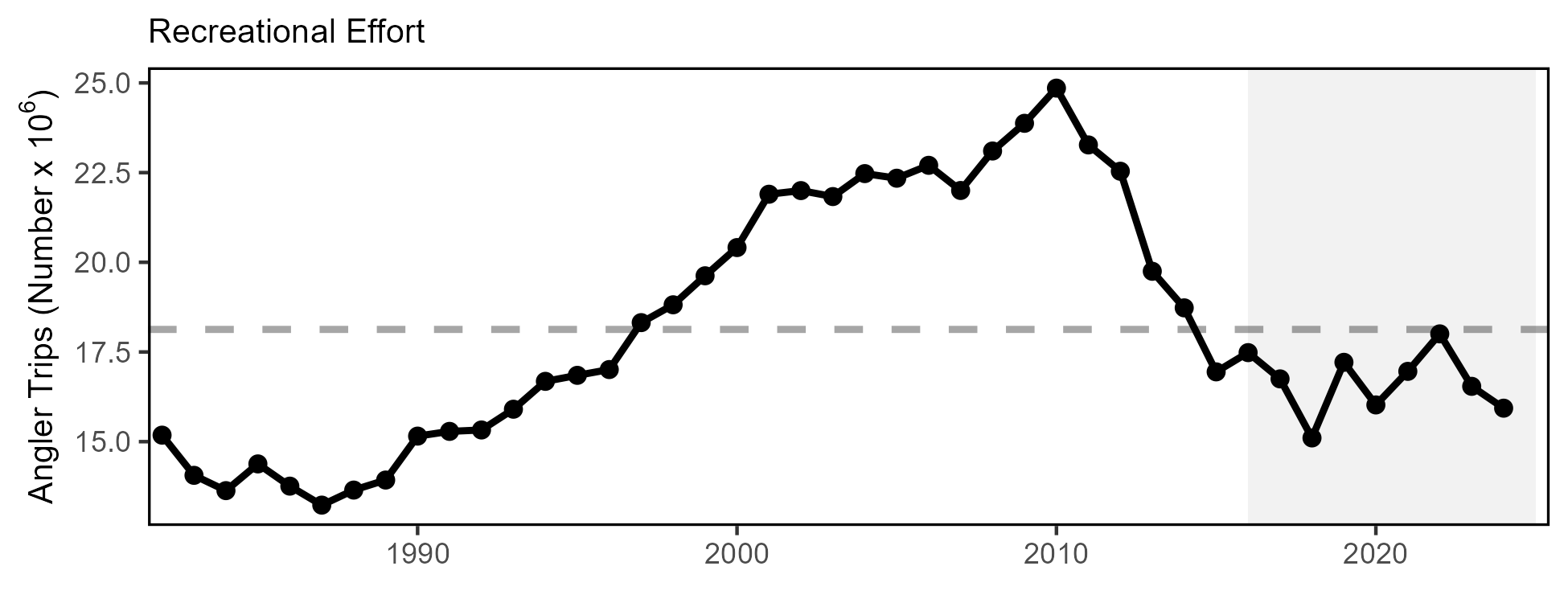
Objective: New England Recreational opportunities ![no trend icon]()
![near average icon icon]()
Indicators: Recreational effort and fleet diversity
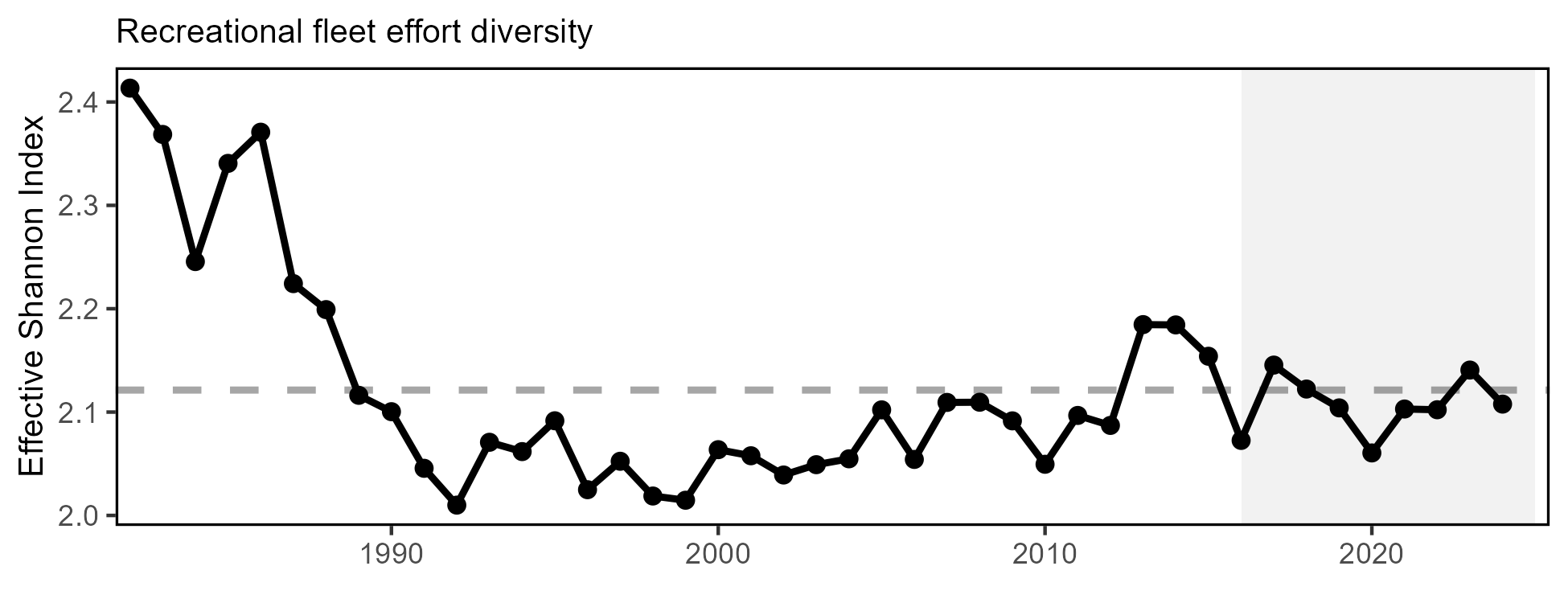
Implications
- Absence of a long-term trend in recreational effort suggests relative stability in the overall number of recreational opportunities in New England
Objective: New England Fishery Stability: Not Stable
Fishery Indicators: Commercial fleet count, fleet diversity
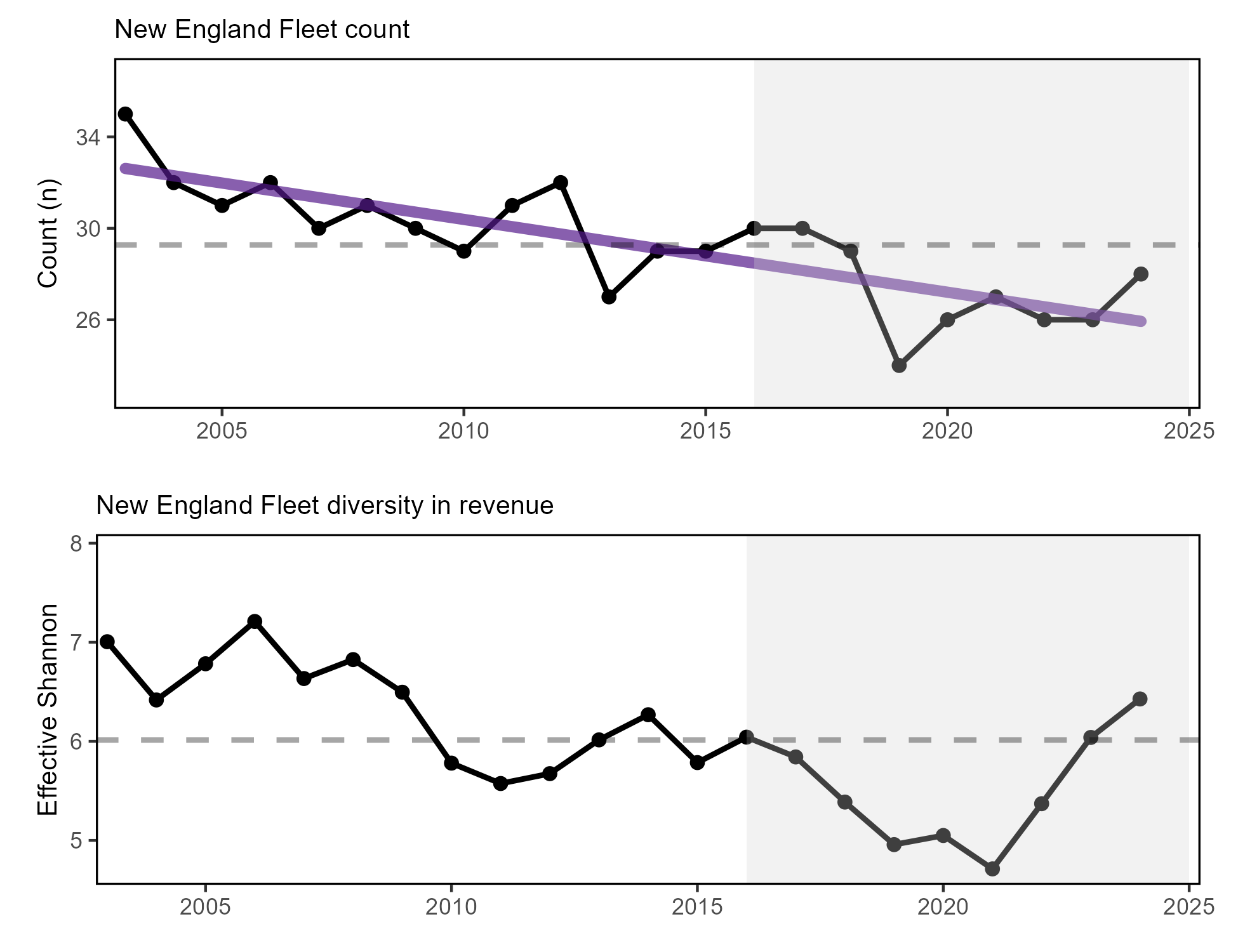
Fishery Implications:
- Commercial fishery diversity driven by small number of species; less capacity to respond to new opportunities
Fishery Indicators: commercial species revenue diversity, recreational species catch diversity
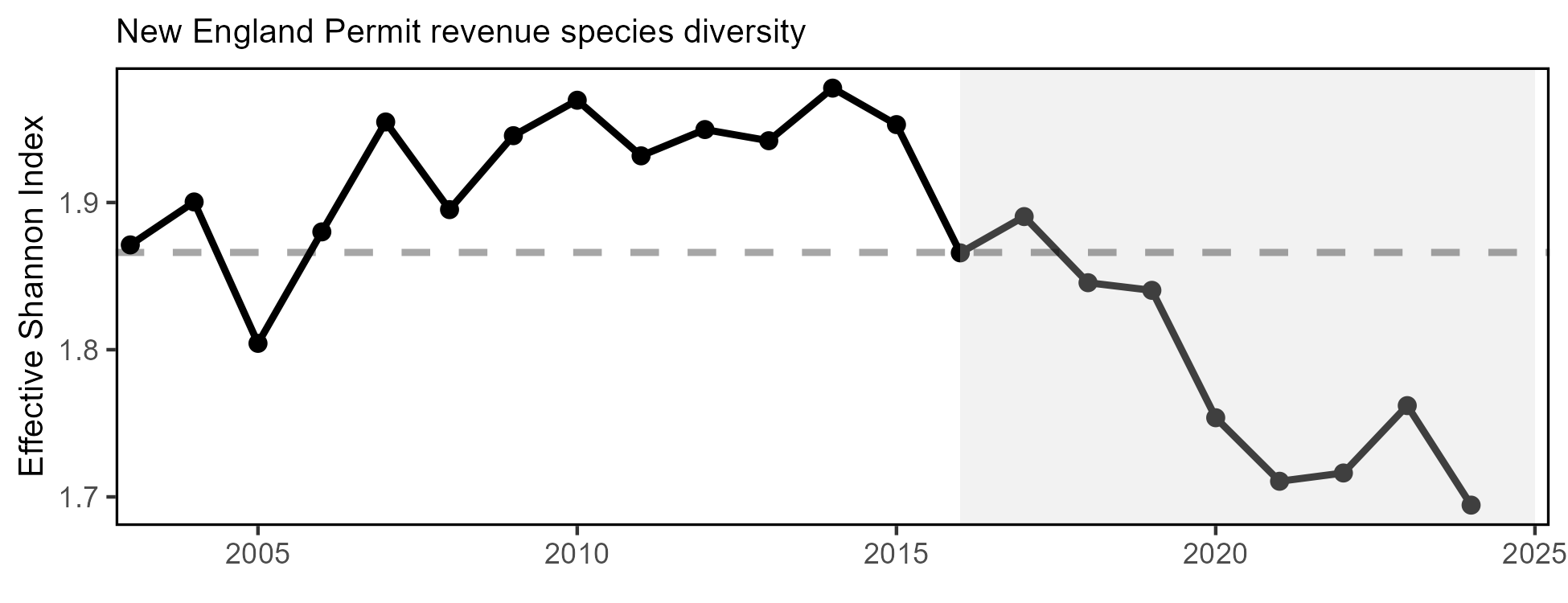
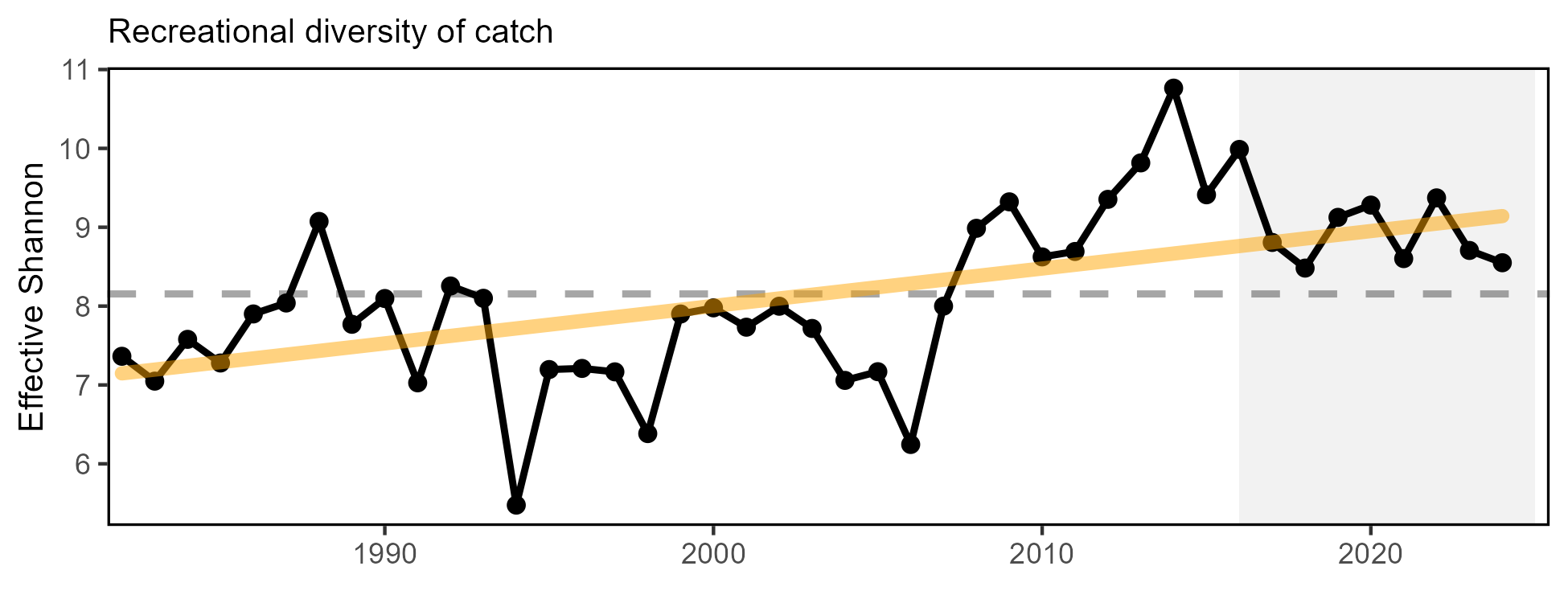
- Recreational diversity increase due to increase in ASFMC and MAFMC managed species
Objective: New England Ecological Stability ![mixed trend icon]()
![above average icon icon]()
Ecological Indicators: zooplankton communities and total primary production


Objective: New England Ecological Stability (Cont.)
Ecological Indicators: fish richness and traits
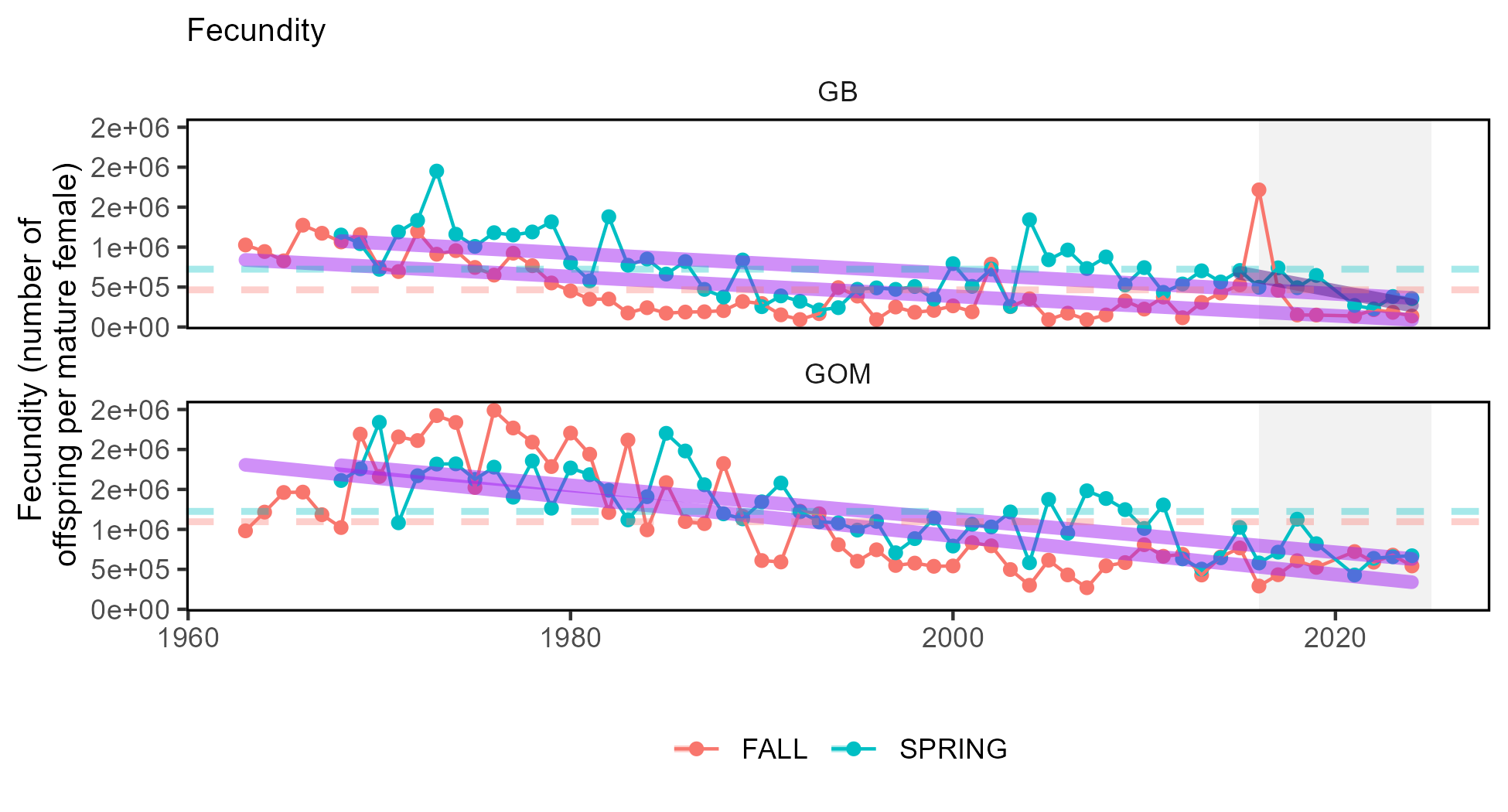
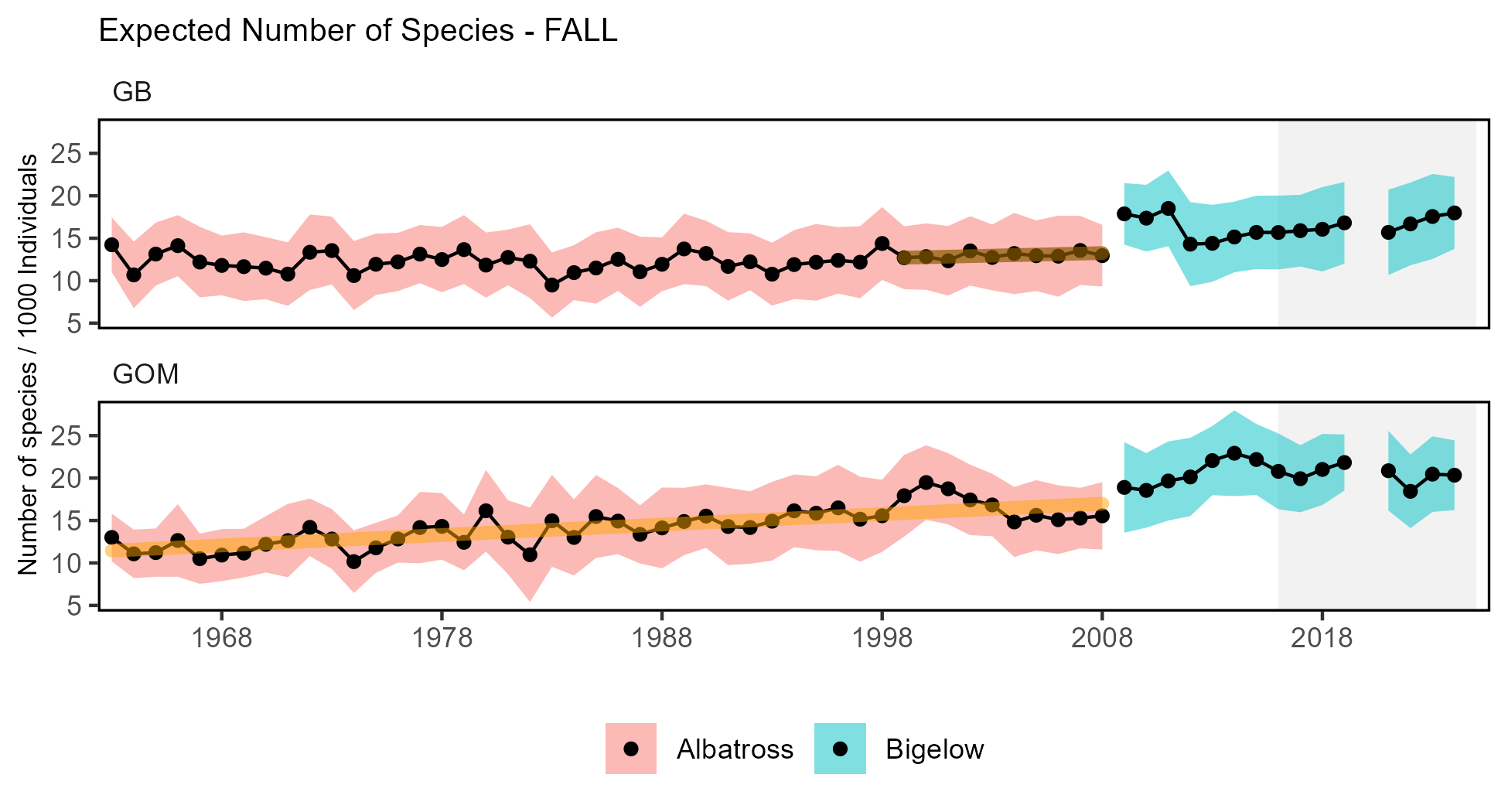
- Declines in species trophic level & other life history traits suggests changing ecology
New England Community Social and Climate Vulnerability
Indicators: Commercial fishery engagement, social vulnerability, revenue climate vulnerability

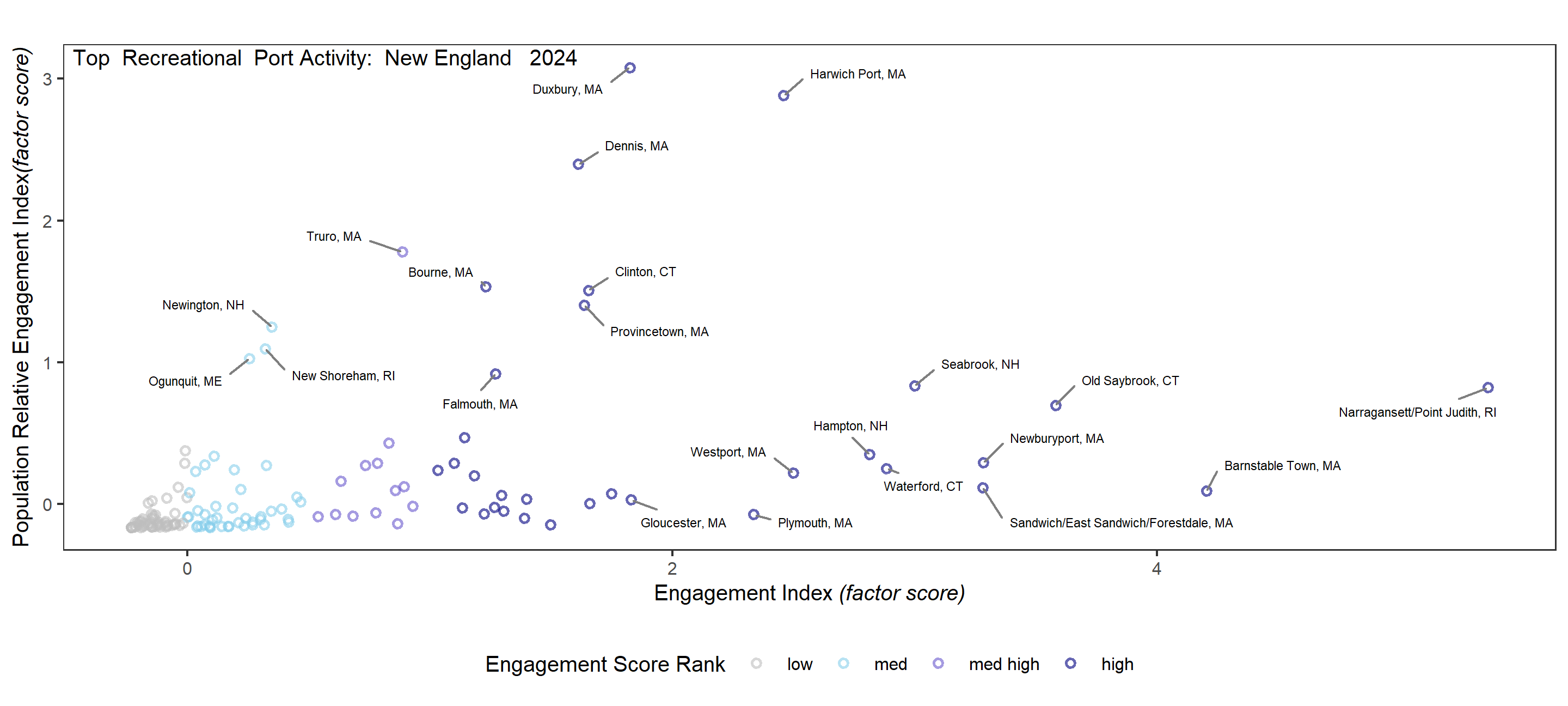
Implications: Highlighted communities may be vulnerable to changes in fishing patterns due to regulations and/or climate change. When also experiencing social vulnerabilities, they may have lower ability to successfully respond to change.
New England Community Social and Climate Vulnerability
Indicators: Commercial fishery revenue climate vulnerability

The Community Climate Change Risk Indicators are calculated by multiplying the percent contribution of species to the total value landed in a community by their respective Total Vulnerability scores (based on NOAA’s Climate Vulnerability Assessment) for different sensitivity and exposure factors and then summing the resulting values by year.
New England communities shifting towads High/Very High climate vulnerability. Consolidating Species

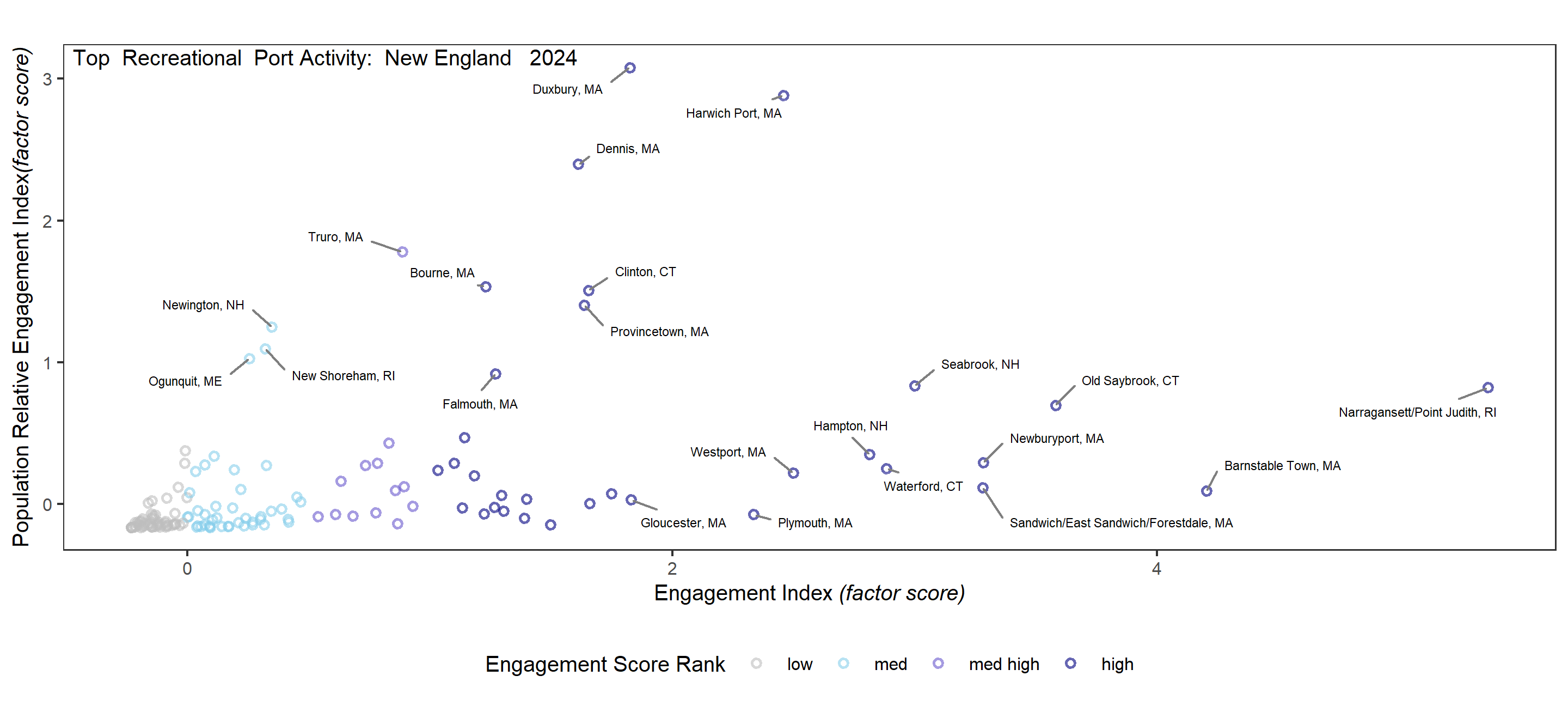
New England Community Social and Climate Vulnerability
Indicators: Recreational fishery engagement, social vulnerability

Objectives: Coastwide Protected species Maintain bycatch below thresholds ![mixed trend icon]()
![meeting objectives icon]()
Indicators: Harbor porpoise and gray seal bycatch


Implications:
Currently meeting objectives, but uncertainty in gray seal estimates
The downward trend in harbor porpoise bycatch can also be due to a decrease in harbor porpoise abundance in US waters, reducing their overlap with fisheries, and a decrease in gillnet effort.
Gray seal among the highest bycatch of any U.S. marine mammal. The increasing trend in gray seal bycatch may be related to an increase in the gray seal population (U.S. pup counts).
Objectives: Coastwide Protected species Recover endangered populations ![decreasing arrow icon]()
![below average icon icon]()
Indicators: North Atlantic right whale population, calf counts


Implications:
Signs the adult population stabilized 2020-2023
Population drivers for North Atlantic Right Whales (NARW) include combined fishery interactions/ship strikes, distribution shifts, and copepod availability.
Additional potential stressors include offshore wind development, which overlaps with important habitat areas used year-round by right whales, including mother and calf migration corridors and foraging habitat.
Unusual mortality events continue for 3 large whale species.

2025 Risks to meeting fishery management objectives


Risks to Managing Spatially: Coastwide
Fish distribution shifts
Megabenthos distribution shifts

Cetacean distribution shifts
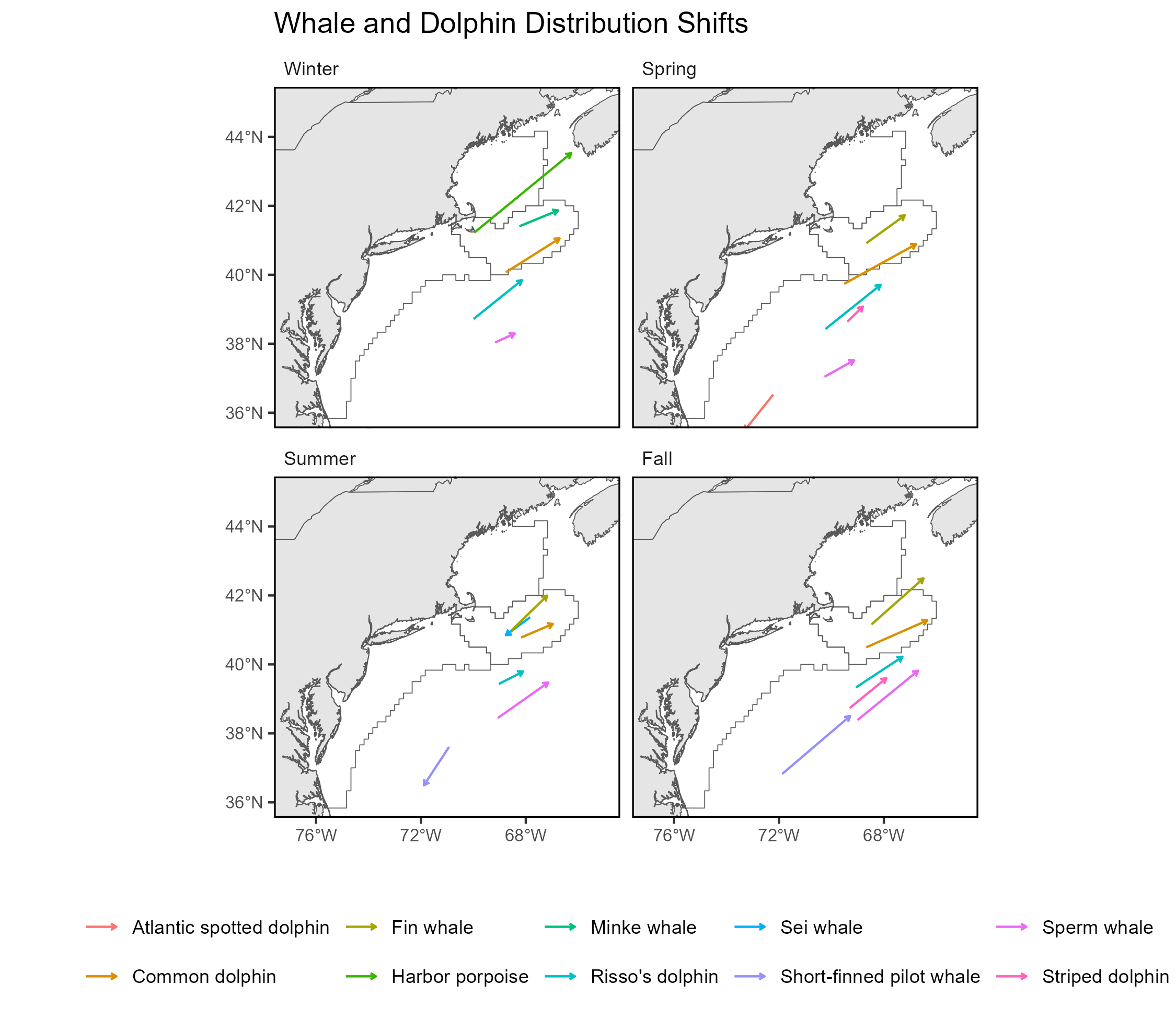
Risks to Managing Spatially: Coastwide
Drivers: Forage shifts, pelagic and benthic


Risks to Managing Spatially: Coastwide
Drivers: shifts in zooplankton – Copepods center of gravity from ECOMON
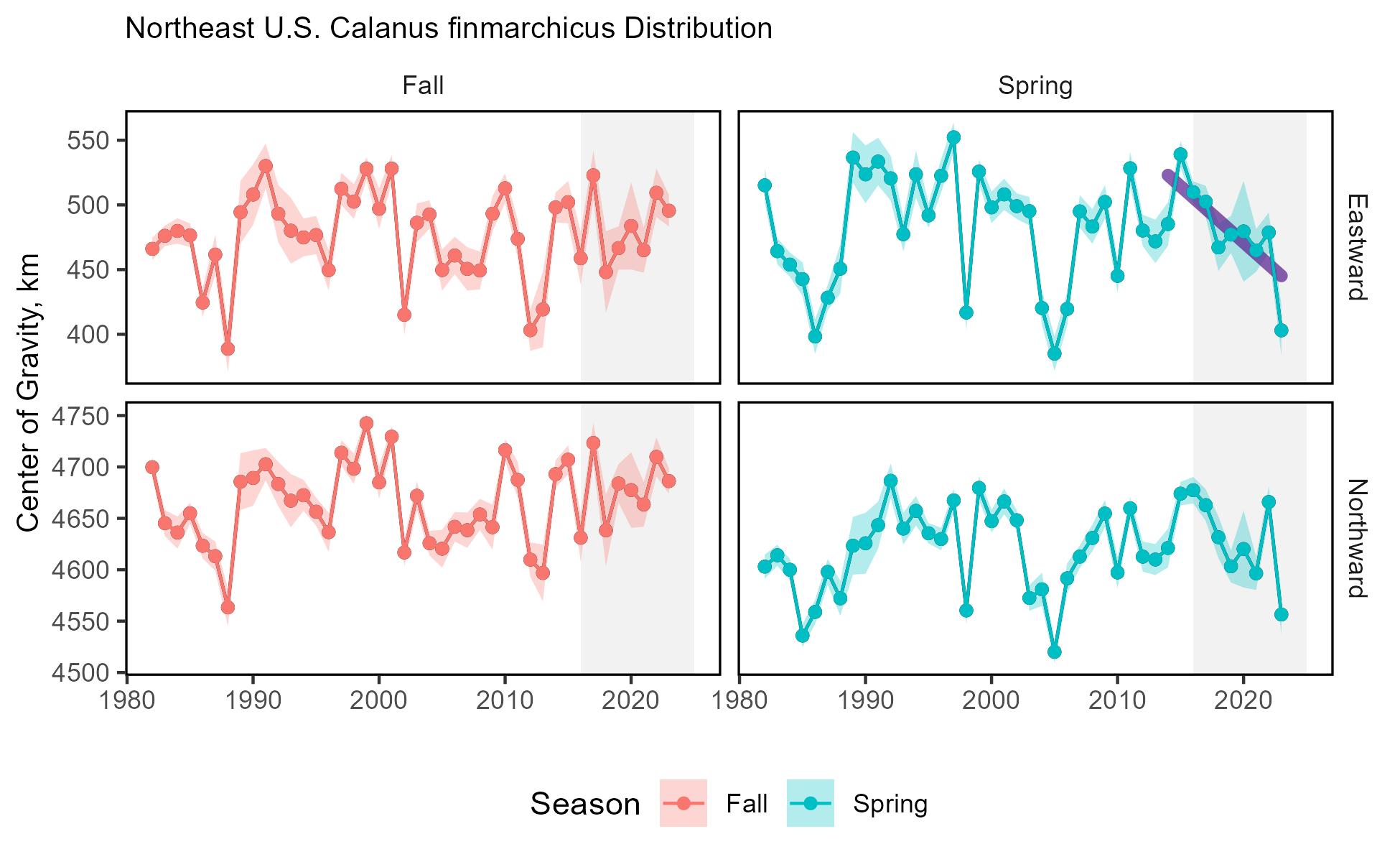


Risks to managing spatially: Coastwide
Drivers: changing ocean habitat
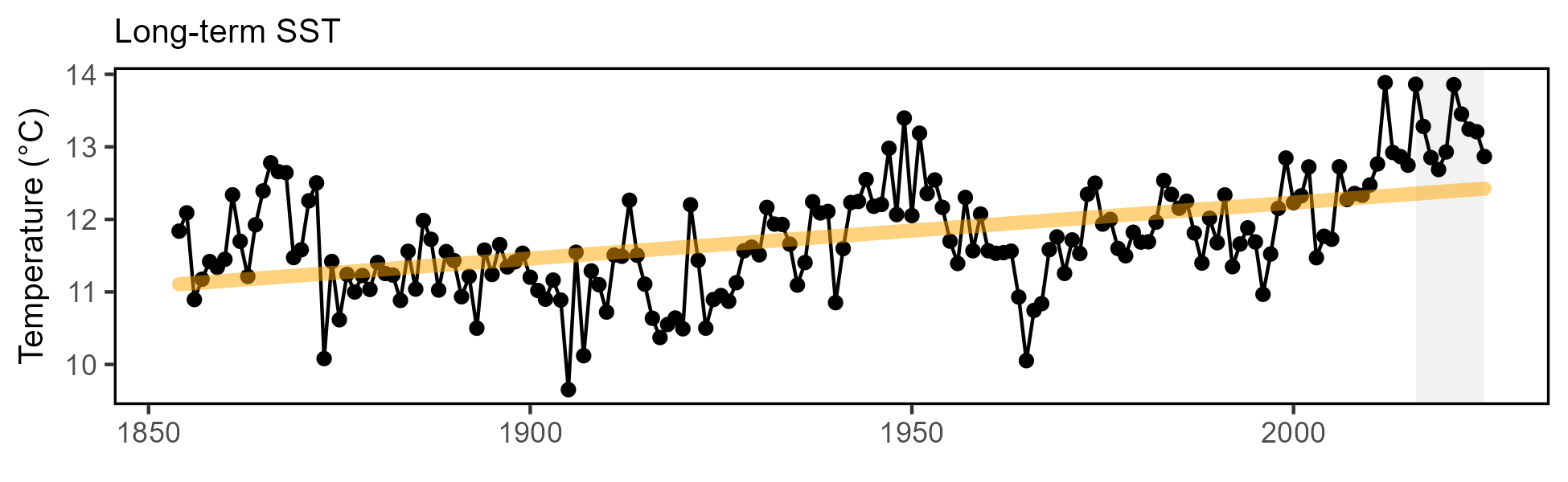
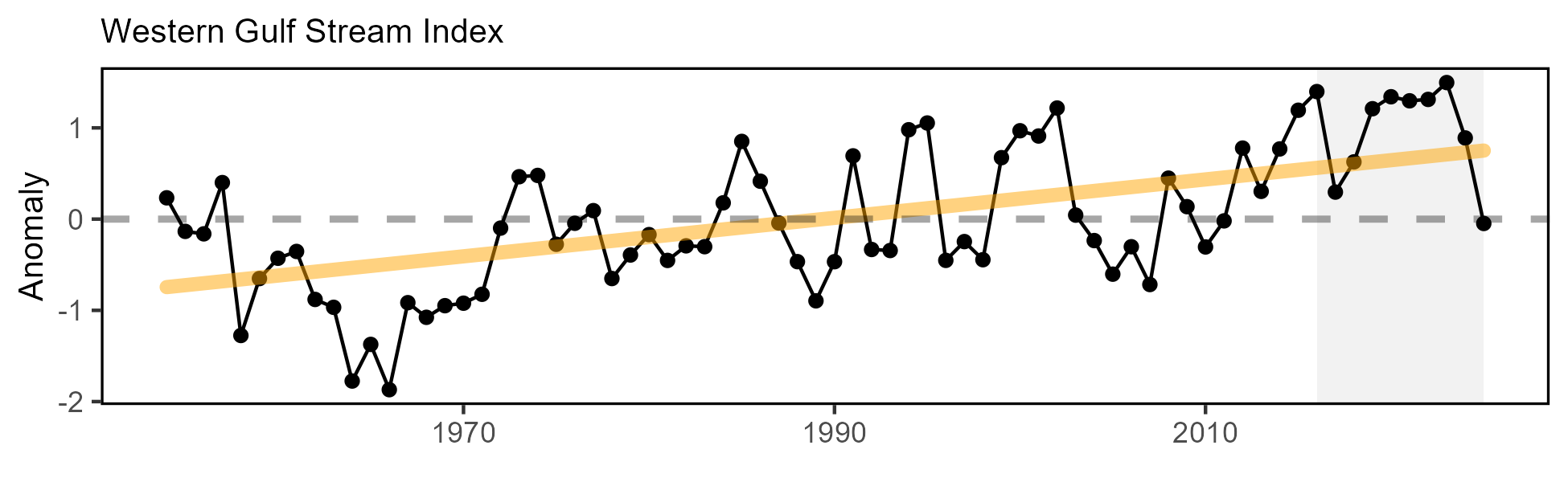
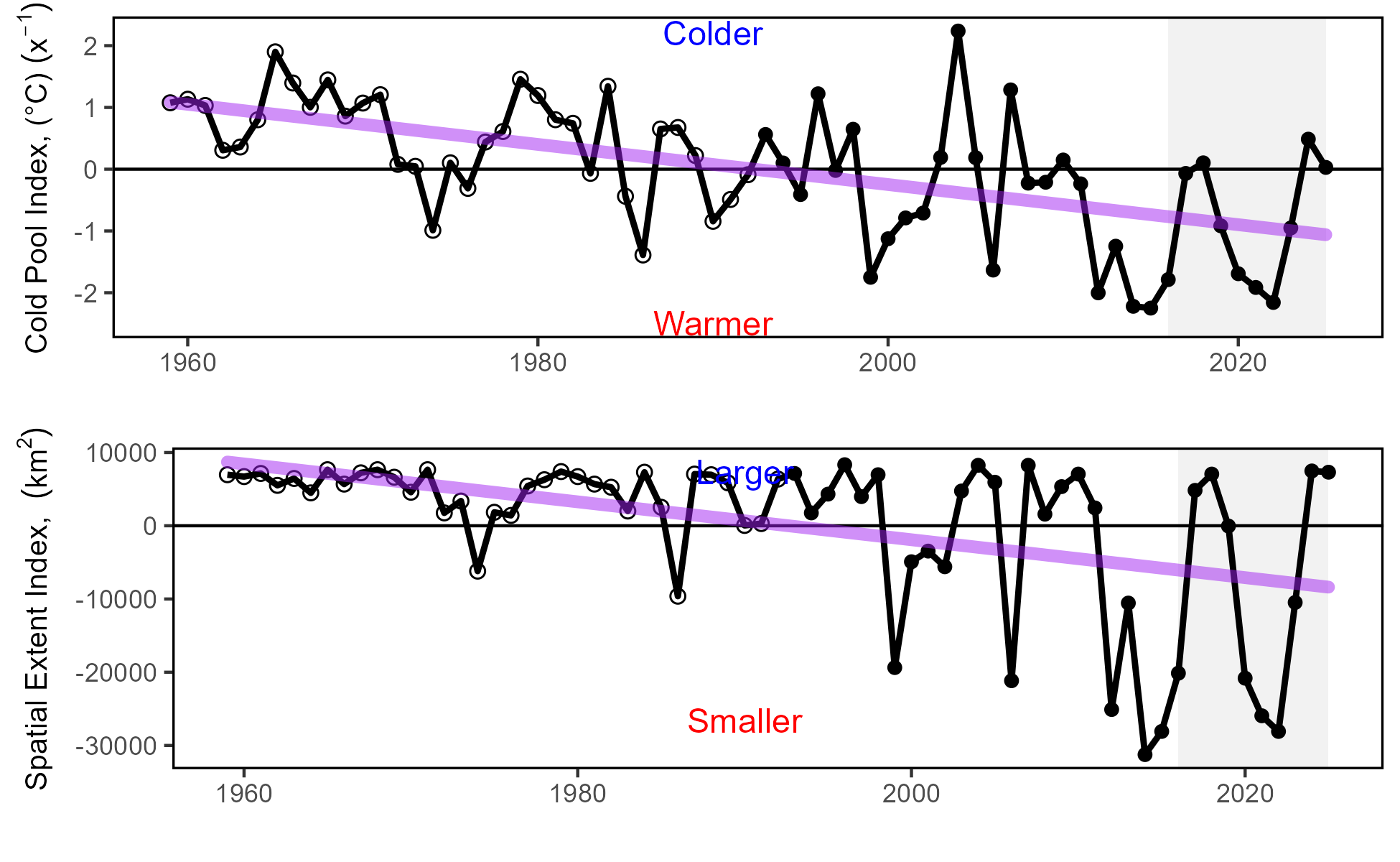
Add things on heatwaves, cold spells, thermal habitat here?
New Spatial Shift Indicators: Benthos, Zooplankton
Benthos center of gravity from fish stomachs
Copepods center of gravity from ECOMON
Risks to Managing Spatially: Coastwide
Future considerations
Distribution shifts caused by changes in thermal habitat and ocean circulation are likely to continue as long as long-term trends persist. Episodic and short-term events (see 2024 Highlights) may increase variability in the trends, however species distributions are unlikely to reverse to historical ranges in the short term. Increased mechanistic understanding of distribution drivers is needed to better understand future distribution shifts: species with high mobility or short lifespans react differently from immobile or long lived species.
Long-term oceanographic projections forecast a temporary pause in warming over the next decade due to internal variability in circulation and a southward shift of the Gulf Stream. Near-term forecasts are being evaluated to determine how well they are able to predict episodic and anomalous events that are outside of the long-term patterns.
Adapting management to changing stock distributions and dynamic ocean processes will require continued monitoring of populations in space and evaluating management measures against a range of possible future spatial distributions. Processes like the East Coast Climate Scenario Planning, and subsequent formation of the East Coast Climate Coordination Group, can help coordinate management.

Risks to Managing Seasonally: Coastwide
Indicators: spawning timing, migration change

Recreational tuna fisheries 50 days earlier in the year in 2019 compared to 2002.
In Cape Cod Bay, peak spring habitat use by right and humpback whales has shifted 18-19 days later over time.
Baseline information on large whale seasonal presence has been collected.
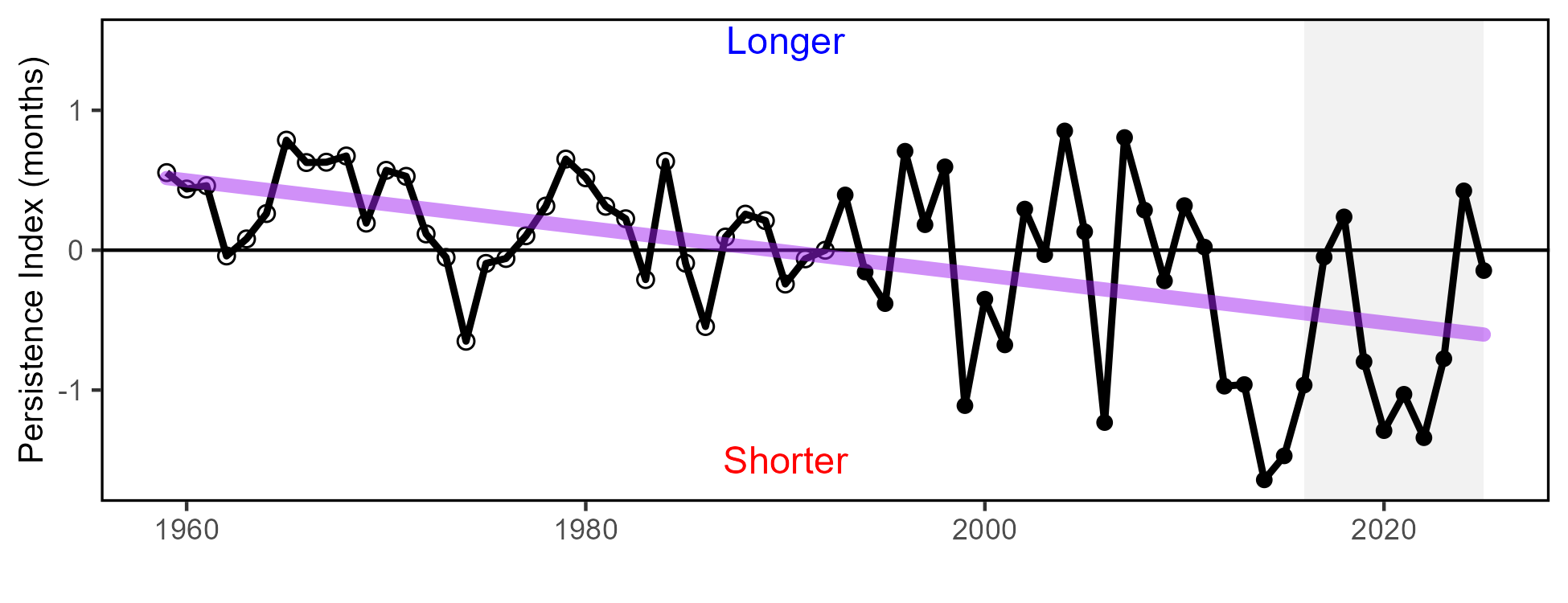
Risks to Managing Seasonally: New England
Drivers: thermal transition, habitat persistence, bloom timing


Future considerations
Management actions that rely on effective alignment of fisheries availability and biological processes should continue to evaluate whether prior assumptions on seasonal timings still hold.
New indicators should be developed to monitor timing shifts for stocks.
Risks to Setting Catch Limits: New England
Indicator: Fish productivity

Risks to Setting Catch Limits: New England
Indicator: Condition

Risks to Setting Catch Limits: New England Drivers
Drivers: Forage Quality and Abundance
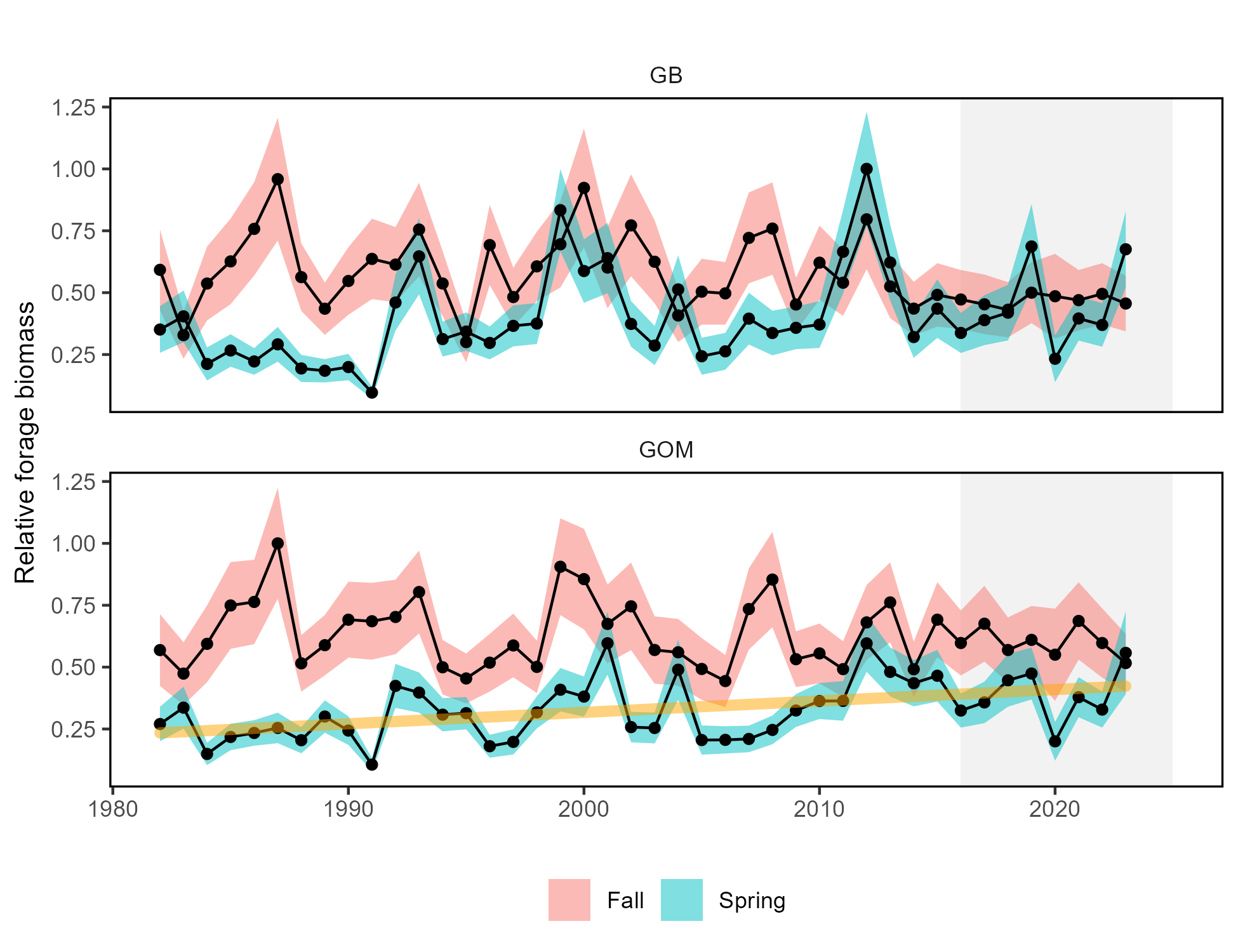
New indicators: benthos abundance

Risks to Setting Catch Limits: New England Drivers
Drivers: Low trophic levels
Risks to Setting Catch Limits: New England Drivers
Changes in fish traits


Risks to Setting Catch Limits: Coastwide
Drivers: Environmental
2024 Thermal habitat area by depth
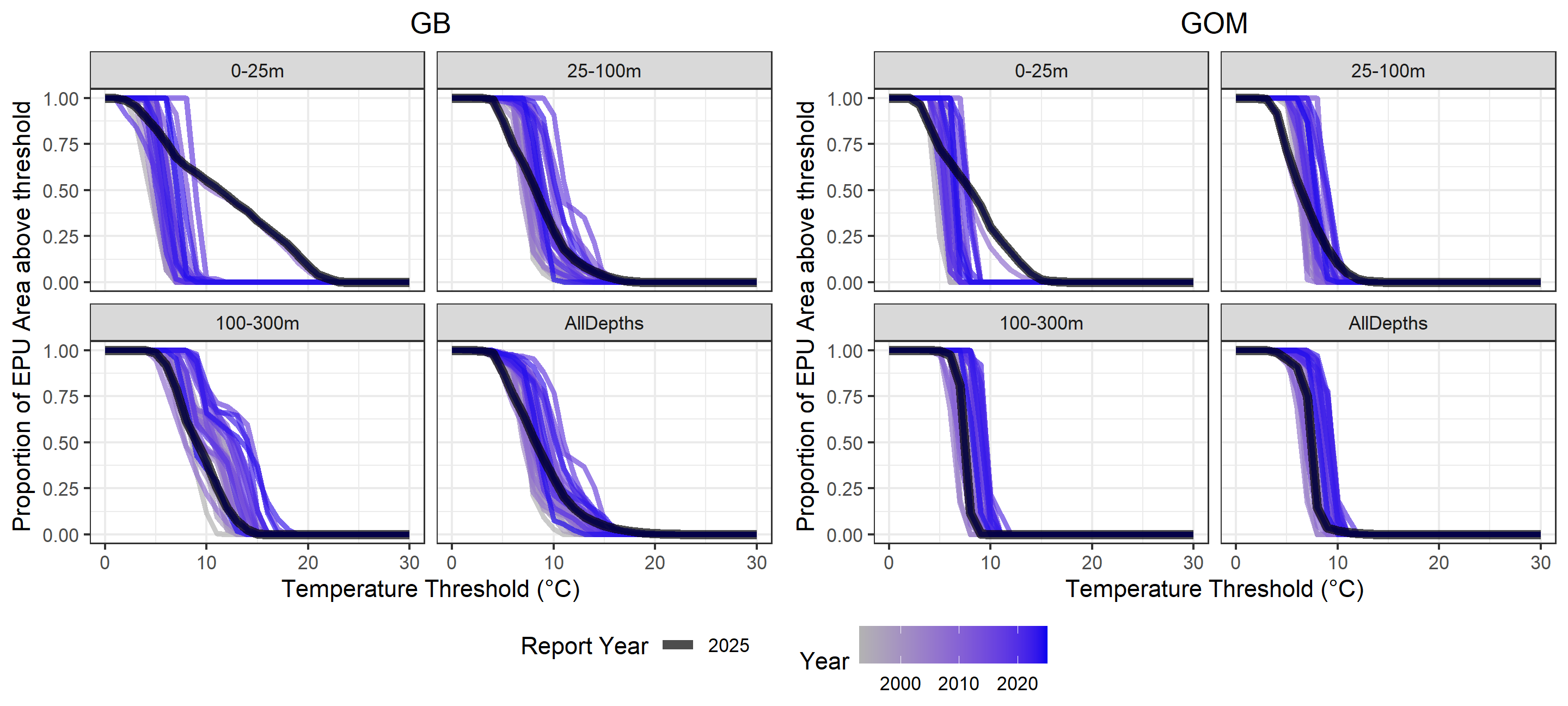
Risks to Setting Catch Limits: Coastwide
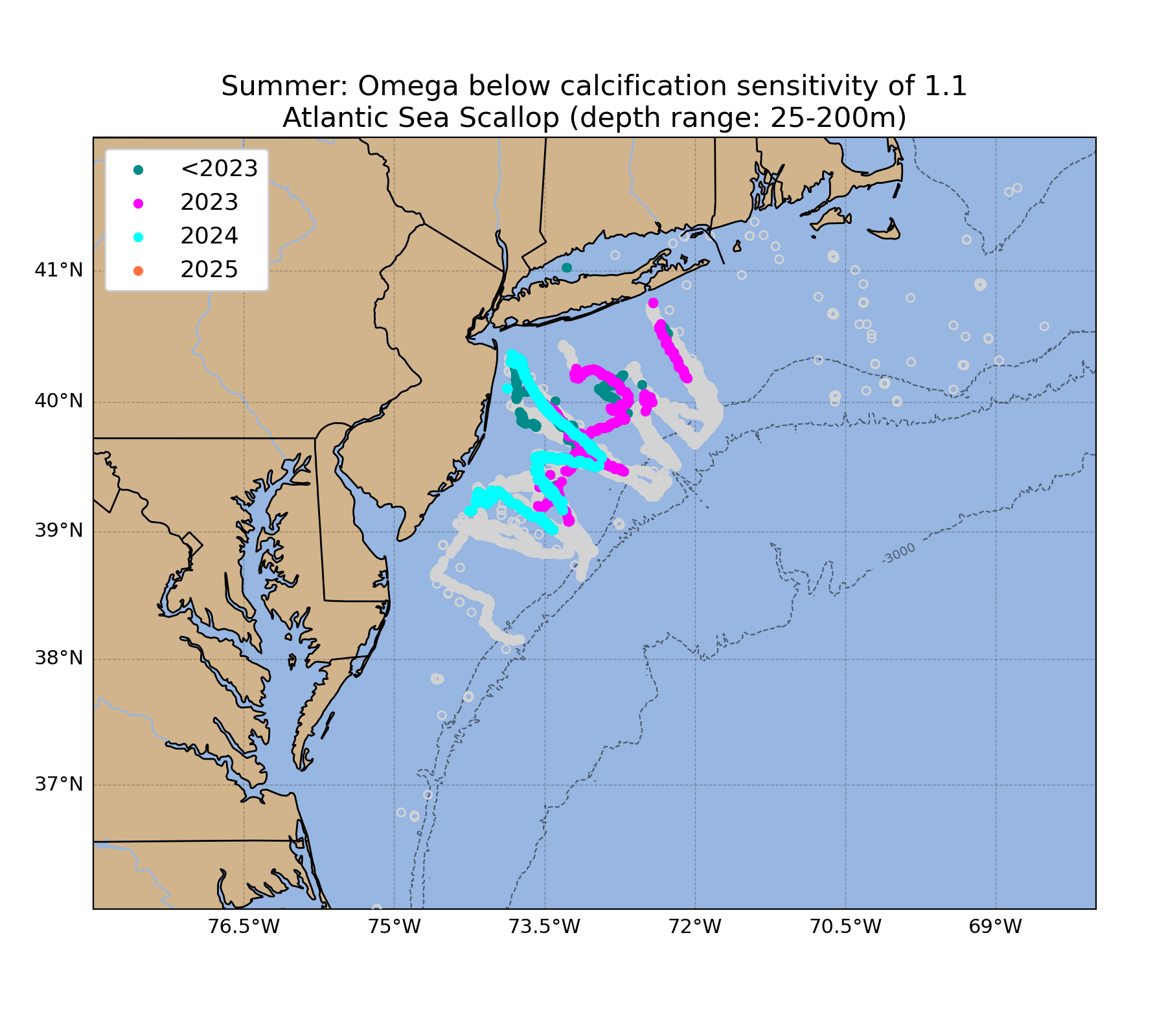
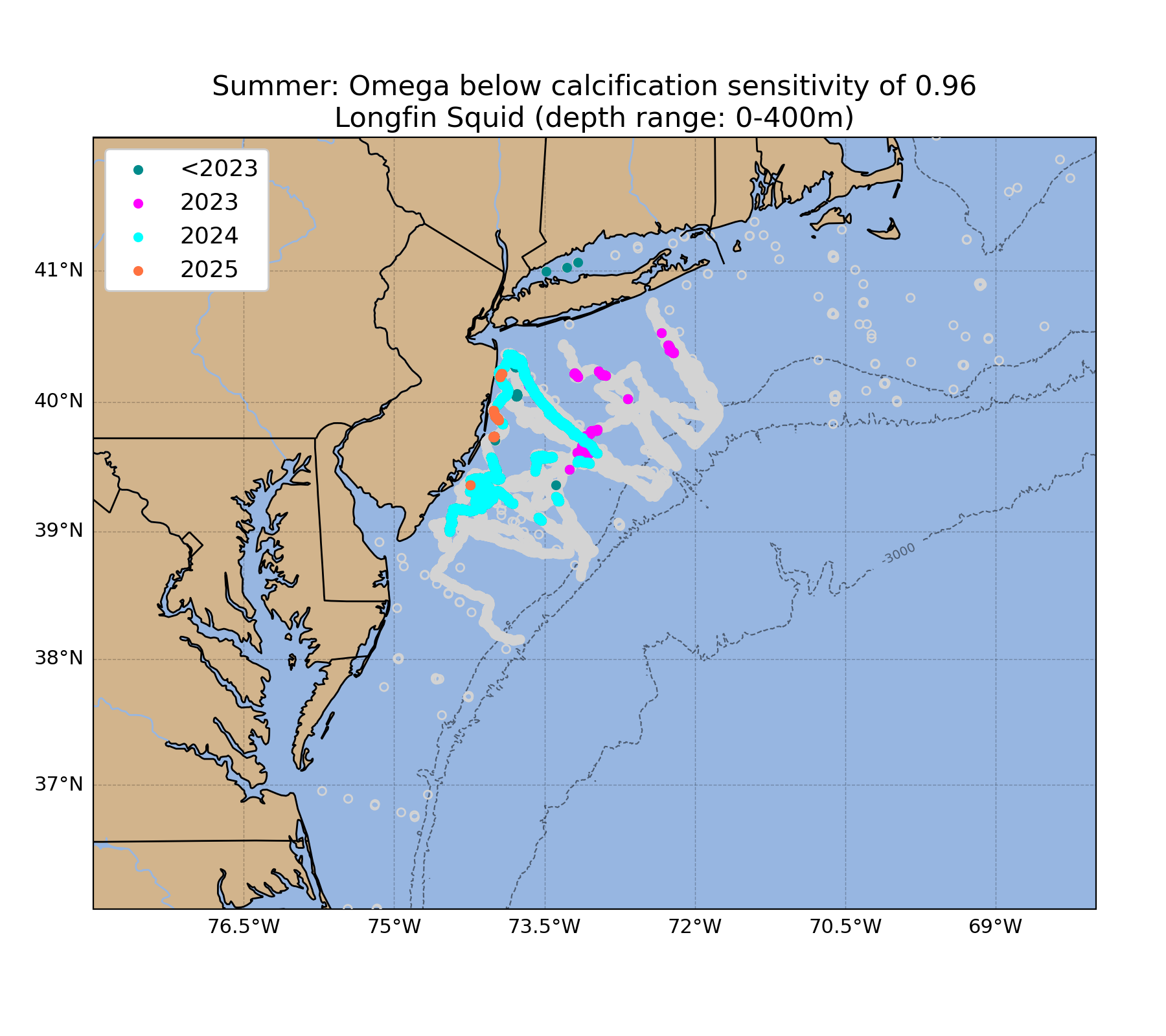
Drivers: Environmental Potential Ocean Acidification Impacts: Scallops and Longfin squid
Drivers: Predation
Seals increasing, mix of population status for HMS, advection
Risks to Setting Catch Limits
Future considerations
Processes that control fish productivity and mortality are dynamic, complex, and are the result of the interactions between multiple changing system drivers.
There is a real risk that short-term predictions in assessments and rebuilding plans that assume unchanging underlying conditions will not be as effective, given the observed change documented in the prior sections in both ecological and environmental processes.
Assumptions for species’ growth, reproduction, and natural mortality should continue to be evaluated for individual species.
With observations of system-wide productivity shifts of multiple managed stocks, more research is needed to determine whether regime shifts or ecosystem reorganization are occurring, and how this should be incorporated into management.
Risks: Offshore Wind Development New England
Indicators: fishery and community specific revenue in lease areas

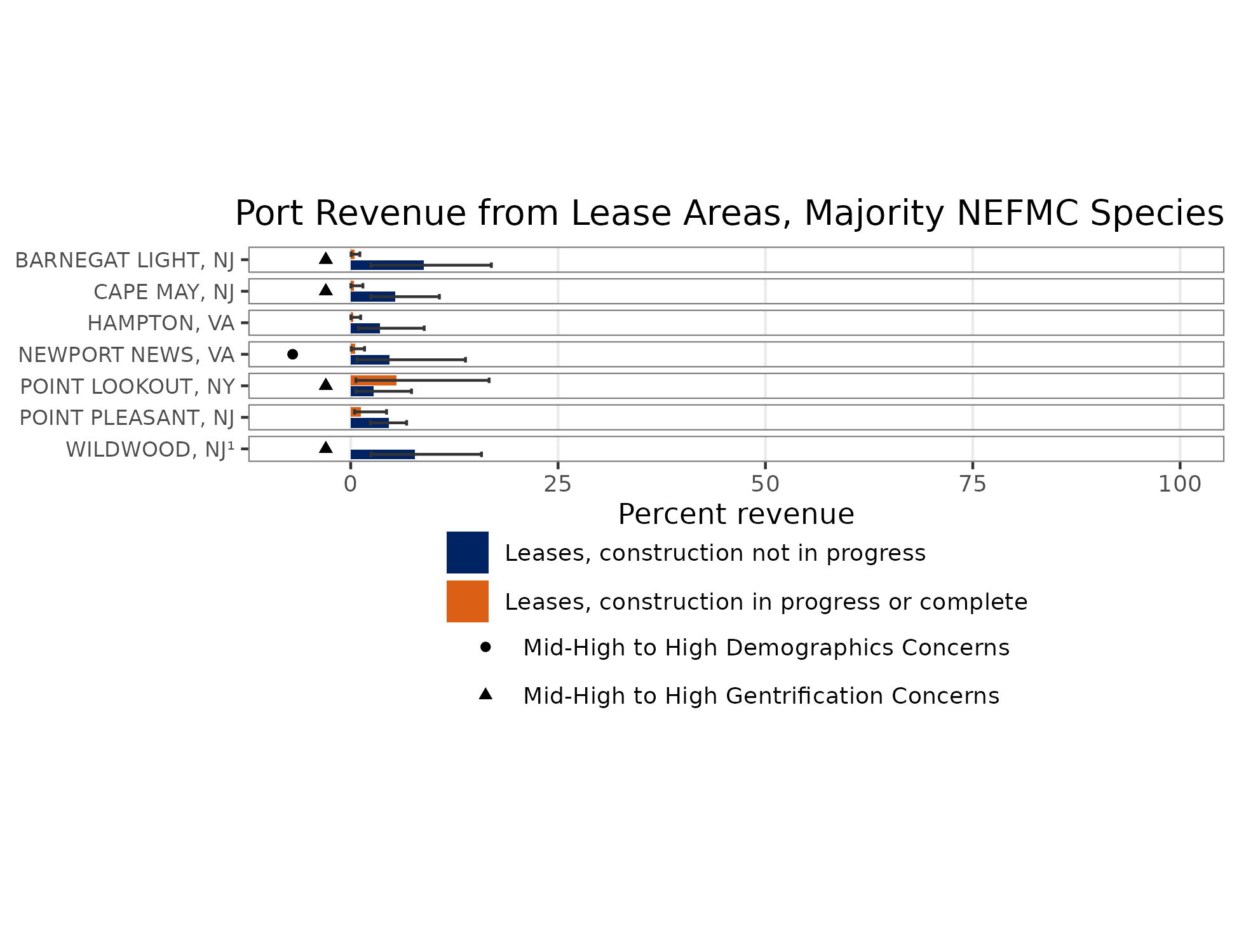

Left: Council request: Mid-Atlantic ports relying on New England managed species
Risks: Offshore Wind Development: Implications
Implications:
Current plans for buildout of offshore wind in a patchwork of areas spreads the impacts differentially throughout the region.
Lease areas overlap with North Atlantic right whale habitat. Development may alter local oceanography and prey availability, increase vessel strike risk, and result in pile driving noise impacts.

2024 Highlights: Methods
Observations solicited from:
- SOE contributors
- NEFSC colleagues
- Academic colleagues
- Management partners
- Fishing industry
We welcome your observations! northeast.ecosystem.highlights@noaa.gov
Observations included if:
- Record high or low observations
- Different from recent conditions
- Reported by multiple sources
- Affecting fishery operations
- Newsworthy
Not exhaustive list; Full impacts remain to be seen
Reprinted from Cape Cod Commercial Fisherman’s Alliance February 2025 Newsletter →

2024 Highlights: generally cooler, fresher Northeast Shelf
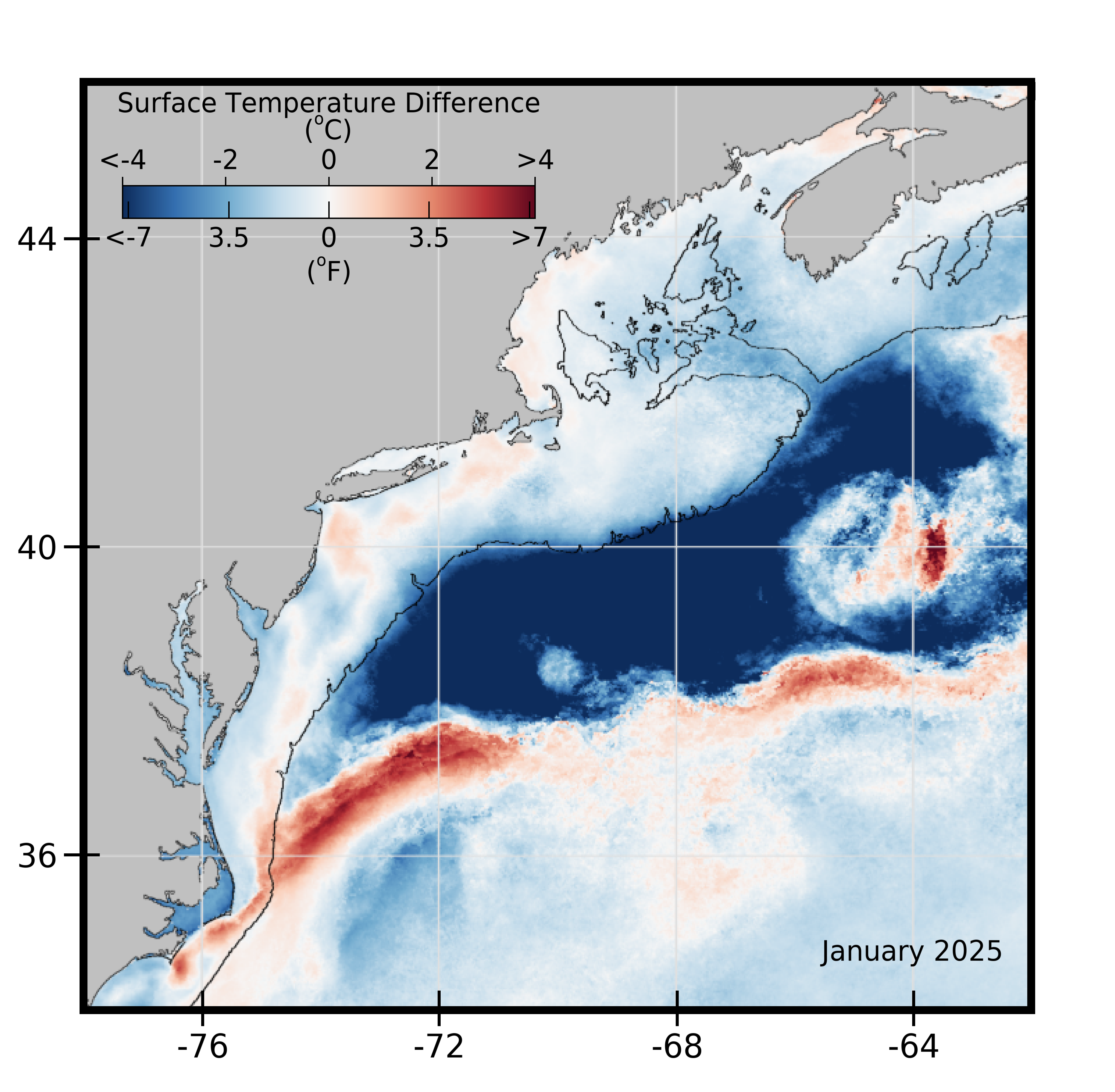
Globally, 2024 warmest year on record (above previous record 2023)
BUT, nearly all NE shelf seasonal surface and bottom temperatures back to longer term average
2023-2024 data suggest more Labrador slope water into the GOM (Record et al., 2024)

Linked to well-developed 2024 Mid Atlantic Cold Pool
2024 Highlights
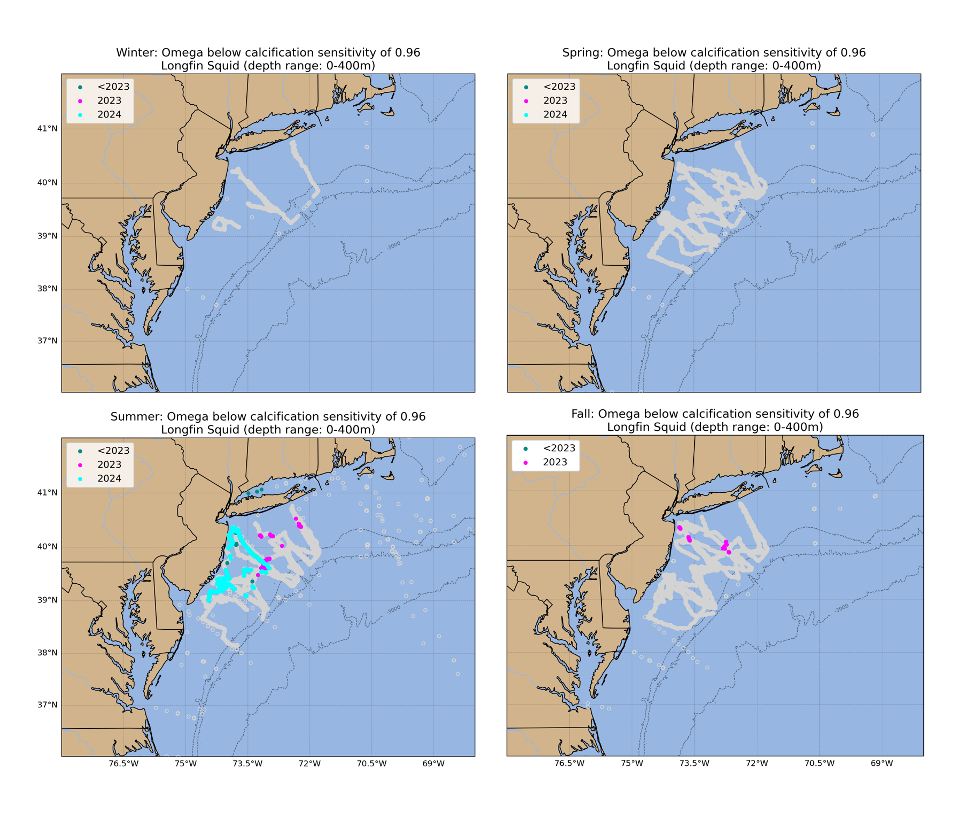
Extreme observation of ocean acidification risk off NJ
Multiple summer upwelling events off NJ
Unusual timing, location, abundance:
Fishery observations
- Delayed migration of longfin squid, black sea bass, haddock
- Unusual locations for pollock, bluefin tuna, Atlantic mackerel, longfin squid, bluefish, and bonito
- Local abundance of Atlantic mackerel
- Record catches of red drum in Chesapeake Bay
Good scallop recruitment in Nantucket lightship
Arctic copepods in GOM
Cocolithophore bloom off NY
Large whale aggregations
THANK YOU! SOEs made possible by (at least) 88 contributors from 20+ institutions
Andrew Applegate (NEFMC)
Kimberly Bastille
Aaron Beaver (Anchor QEA)
Andy Beet
Brandon Beltz
Ruth Boettcher (Virginia Department of Game and Inland Fisheries)
Mandy Bromilow (NOAA Chesapeake Bay Office)
Joseph Caracappa
Samuel Chavez-Rosales
Baoshan Chen (Stony Brook University)
Zhuomin Chen (UConn)
Doug Christel (GARFO)
Patricia Clay
Lisa Colburn
Jennifer Cudney (NMFS Atlantic HMS Management Division)
Tobey Curtis (NMFS Atlantic HMS Management Division)
Art Degaetano (Cornell U)
Geret DePiper
Bart DiFiore (GMRI)
Emily Farr (NMFS Office of Habitat Conservation)
Michael Fogarty
Paula Fratantoni
Kevin Friedland
Marjy Friedrichs (VIMS)
Sarah Gaichas
Ben Galuardi (GAFRO)
Avijit Gangopadhyay (SMAST UMass Dartmouth)
James Gartland (VIMS)
Lori Garzio (Rutgers University)
Glen Gawarkiewicz (WHOI)
Laura Gruenburg
Sean Hardison
Dvora Hart
Cliff Hutt (NMFS Atlantic HMS Management Division)
Kimberly Hyde
John Kocik
Steve Kress (National Audubon Society’s Seabird Restoration Program)
Young-Oh Kwon (Woods Hole Oceanographic Institution)
Scott Large
Gabe Larouche (Cornell U)
Daniel Linden
Andrew Lipsky
Sean Lucey (RWE)
Don Lyons (National Audubon Society’s Seabird Restoration Program)
Chris Melrose
Anna Mercer
Shannon Meseck
Ryan Morse
Ray Mroch (SEFSC)
Brandon Muffley (MAFMC)
Robert Murphy
Kimberly Murray
NEFSC staff
David Moe Nelson (NCCOS)
Chris Orphanides
Richard Pace
Debi Palka
Tom Parham (Maryland DNR)
CJ Pellerin (NOAA Chesapeake Bay Office)
Charles Perretti
Kristin Precoda
Grace Roskar (NMFS Office of Habitat Conservation)
Jeffrey Runge (U Maine)
Grace Saba (Rutgers University)
Vincent Saba
Sarah Salois
Chris Schillaci (GARFO)
Amy Schueller (SEFSC)
Teresa Schwemmer (URI)
Tarsila Seara
Dave Secor (CBL)
Emily Slesinger
Angela Silva
Adrienne Silver (UMass/SMAST)
Talya tenBrink (GARFO)
Abigail Tyrell
Rebecca Van Hoeck
Bruce Vogt (NOAA Chesapeake Bay Office)
Ron Vogel (University of Maryland Cooperative Institute for Satellite Earth System Studies and NOAA/NESDIS Center for Satellite Applications and Research)
John Walden
Harvey Walsh
Sarah Weisberg
Changhua Weng
Dave Wilcox (VIMS)
Timothy White (Environmental Studies Program BOEM)
Sarah Wilkin (NMFS Office of Protected Resources)
Mark Wuenschel
Qian Zhang (U Maryland)
